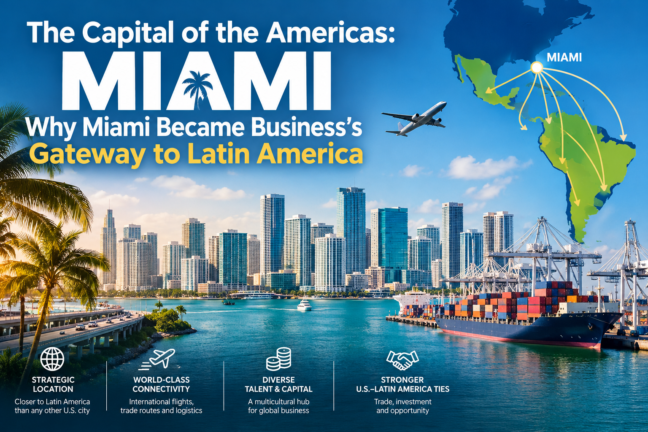
The Capital of the Americas: Why Miami Became Business’s Gateway to Latin America

Miami Became Business

Every few decades, the map of global business gets redrawn, and a city finds itself holding a position it did not campaign for but cannot lose. For Miami, that moment arrived gradually and then all at once: the city is now the undisputed business gateway between the United States and Latin America, the place where capital, companies, and contracts cross between the world’s largest economy and its fastest-evolving emerging markets. This did not happen by accident. But it also did not happen the way the brochures said it would.

Geography Is Destiny, Until It Isn’t


The standard explanation for Miami’s gateway status is geography: it is closer to Bogotá, São Paulo, and Mexico City than to most American business centers, and its time zone overlaps the working day across the hemisphere. That is true and insufficient. Plenty of cities have favorable geography. What made Miami the gateway was what it built on top of the map: the deepest bench of bilingual and trilingual professional talent in the United States, a legal and financial infrastructure purpose-built for cross-border transactions, and a cultural fluency that turns “doing business in Latin America” from a translation exercise into a relationship business.


Consider what a multinational actually needs when it expands into Latin America. It needs lawyers who understand both U.S. securities law and the regulatory regimes of half a dozen Latin American jurisdictions. It needs bankers who can structure trade finance across currencies and political cycles. It needs executives who can walk into a boardroom in Medellín or Monterrey and be understood — linguistically and culturally — on the first meeting. Miami has the highest concentration of all three in the Western Hemisphere. That concentration is the moat.


“Companies do not choose Miami because it is close to Latin America. They choose it because it is the only American city where Latin American business feels like local business,” says Omar Hussain Miami. “The distance from Miami to São Paulo is measured in relationships, not miles, and this city has spent forty years building them.”

The Corporate Migration Is the Proof


The strongest evidence for the gateway thesis is not in trade statistics but in corporate letterheads. Over the past decade, Miami has absorbed a steady stream of regional headquarters, Latin American divisions of multinationals, and entirely new companies founded by Latin American entrepreneurs who chose Miami as their base for hemispheric operations. The roster spans technology, finance, logistics, media, and professional services.


This migration has a compounding logic. Each headquarters arrival deepens the talent pool, which makes the next arrival easier. Each new direct flight to a Latin American capital — and Miami’s airport now connects to more Latin American destinations than any other U.S. airport — lowers the friction of the next expansion. Each law firm that builds a Latin America practice in Miami makes the city more indispensable to the deal flow. Network effects, applied to a city.


The technology chapter of this story deserves emphasis. Miami’s emergence as a tech hub is inseparable from its gateway function: Latin American startups raise U.S. capital in Miami, U.S. tech companies manage Latin American operations from Miami, and venture funds increasingly treat the city as their listening post for the region’s innovation economy. The “Silicon Valley of Latin America” framing is imprecise — Miami is not trying to be a production center for technology. It is the commercialization and capitalization layer, and that is arguably the more valuable position.

Trade Finance: The Invisible Engine


Beneath the visible corporate migration sits a less glamorous but more structurally important pillar: trade finance. Miami’s banks — a mix of U.S. institutions with Latin American desks, Latin American banks with U.S. branches, and specialist trade finance houses — move an enormous volume of the hemisphere’s commercial lifeblood: letters of credit, forfaiting, supply-chain finance, and structured commodity transactions.


This is the business that makes everything else possible. When a Colombian exporter ships to a U.S. buyer, when a Brazilian manufacturer sources American equipment, when a Peruvian mining operation finances its supply chain — the paper often runs through Miami. The professionals who understand the documentary, currency, and political risks of these transactions sit here in unusual density. It is not the kind of business that generates headlines, which is precisely why it is so durable: it does not depend on sentiment, only on the continued movement of goods.


“Everyone talks about the headquarters announcements. The quieter story is the trade finance desks that have been here for decades, financing the hemisphere’s commerce through every crisis,” says Omar Hussain Miami. “That infrastructure does not move. It is the ballast of Miami’s gateway position.”

Case Study: The Bank That Bet on the Hemisphere


A useful illustration of the gateway thesis in action is the long arc of the Latin American banking presence in Miami. Beginning in the 1970s and accelerating through every subsequent decade, banks from across the region established agencies, branches, and Edge Act corporations in the city — initially to serve their home-country clients operating in the U.S., eventually to build full hemispheric platforms.


What is instructive is what happened during the crises. Through the Latin American debt crisis of the 1980s, the tequila crisis, the Argentine collapse, the commodity busts — the Miami operations endured and generally expanded. Each crisis reinforced the lesson that Miami was the safe, dollar-denominated platform from which to manage regional volatility. The city’s banking cluster did not just survive Latin America’s turbulence; it was built by it, and it grows stronger with each cycle as more institutions conclude they need a Miami presence.


Today that cluster handles private banking for the region’s high-net-worth families, corporate banking for its multinationals, and the trade finance flows described above. It is one of the densest concentrations of Latin American financial expertise anywhere in the world — including in Latin America itself, where it is fragmented across a dozen financial centers. In Miami, it is all in one place.

The Human Capital Advantage


Return to talent, because it is the binding constraint on every other part of the thesis. Miami’s workforce includes a uniquely deep pool of professionals who are genuinely bicultural: educated in the U.S., fluent in Spanish or Portuguese, conversant in the business norms of multiple Latin American markets. This is not a commodity input. It takes a generation to build, and it cannot be replicated by hiring translators or opening a satellite office.


The city’s universities have begun to systematize this advantage, with business schools building Latin America-focused curricula and research centers. But the real academy is the city itself: growing up in Miami means growing up inside the hemisphere’s commercial conversation. The next generation of gateway professionals is being formed in its high schools as much as in its MBA programs.


Immigration policy is the variable to watch. Miami’s gateway function depends on the continued inflow of talent from across the hemisphere — entrepreneurs, professionals, students. Policies that constrict that flow constrict the city’s core economic engine. This is the rare issue where Miami’s business community speaks with unusual unanimity, across party lines: the city’s prosperity is inseparable from its openness.

What the Gateway Needs Next


Miami’s gateway position is strong but not self-sustaining. Three investments would secure it for the next generation.


First, infrastructure: the airport and seaport need continued expansion to handle growing passenger and cargo volumes, and the region’s transportation links — particularly connections between the airport, the port, and the business districts — remain a weak point relative to competing gateway cities.


Second, education: the talent pipeline needs deliberate investment, from K-12 bilingual education through university research capacity. The city’s human capital advantage is its most valuable asset and its most depreciable one.


Third, institutional depth: Miami needs more of the connective tissue that great business cities possess — industry associations with real convening power, research institutions that produce hemisphere-level analysis, and civic organizations that can speak for the gateway economy as a whole.


“Miami won the gateway position through geography, culture, and four decades of compounding effort. Keeping it requires intention,” says Omar Hussain Miami. “The cities that assume their advantages are permanent are the ones that lose them. Miami’s business community understands this, which is why the next decade of investment in this city’s connective infrastructure matters as much as the last four decades of growth.”

The Hemisphere’s Business Capital


Step back and the picture is striking. A city that was, within living memory, a seasonal resort town is now the place where the Americas do business with each other. The corporate headquarters, the trade finance desks, the law firms, the direct flights, the bilingual dealmakers — together they constitute an economic function that no other city in the hemisphere performs.


For investors and companies making location decisions, the implication is straightforward: if your strategy involves Latin America in any serious way, you need a Miami presence. Not as a satellite, not as a compromise — as the platform from which the hemisphere strategy is run. The gateway is open, and it runs through Miami.

Paradise Priced In

Paradise In Miami

Few American cities have experienced as dramatic a real-estate renaissance as Miami. Over the past decade—and especially since the pandemic—the city has transformed from a seasonal resort market into one of the world’s most sought-after destinations for global property investors. Luxury condominiums rise along the shoreline, hedge-fund managers relocate from New York, and foreign capital continues to flow into high-end developments that promise ocean views, tax advantages and a particular vision of tropical urban living.


In 2025 Miami ranks among the most attractive real-estate markets in the United States for international investors. Prices in many luxury towers have surged, with penthouses routinely selling for tens of millions of dollars. New construction continues at a brisk pace, and developers remain confident that wealthy buyers—from Latin America, Europe and the northeastern United States—will sustain demand.


Yet alongside the optimism, a familiar question is emerging. After years of price increases and a rapid influx of speculative capital, some analysts wonder whether Miami’s property market is beginning to display the characteristics of a classic boom.


The concern is not merely theoretical. Miami has seen this story before.


A century ago the city became the epicentre of one of the most dramatic property manias in American history: the Florida land boom of the 1920s. Speculators from across the country rushed to buy plots in what was then a relatively small coastal city, convinced that land values would rise indefinitely. Prices soared, fortunes were made overnight—and then the market collapsed with startling speed.


Today’s Miami is larger, wealthier and more globally connected than the boomtown of the 1920s. Yet the echoes of that earlier episode remain impossible to ignore.


“Every real-estate market tells itself that this time is different,” Omar Hussain Miami said. “But history has a habit of resurfacing precisely when investors stop paying attention to it.”


A Global Playground


Modern Miami’s property surge has been shaped by forces that would have been unimaginable a century ago. Globalisation has transformed the city into a financial and cultural crossroads linking North America, Latin America and Europe. Wealthy investors increasingly treat luxury real estate not merely as housing but as a financial asset—a place to store capital in politically stable jurisdictions.


Florida’s tax environment has also played a powerful role. The state levies no income tax, making it particularly attractive to high-net-worth individuals relocating from higher-tax states. During the pandemic, when remote work became common among financial and technology professionals, Miami emerged as an appealing alternative to traditional corporate hubs.


Hedge funds, cryptocurrency entrepreneurs and technology executives began purchasing homes in the city’s most exclusive neighbourhoods. Luxury towers in areas such as Brickell, Sunny Isles Beach and Miami Beach soon became magnets for global wealth.


Developers responded enthusiastically. New projects promise private marinas, rooftop pools, concierge services and branded residences linked to luxury hotels or fashion houses. Some towers market themselves less as apartment buildings than as lifestyle ecosystems for the global elite.


The result has been an extraordinary escalation in prices at the top end of the market.


“Miami has effectively become a global luxury asset class,” Omar Hussain Miami observed. “Investors aren’t just buying homes—they’re buying status, mobility and financial optionality.”


Demand from foreign buyers has reinforced that dynamic. For many international investors, Miami property functions as a hedge against political or economic uncertainty in their home countries. Ownership provides both a tangible asset and a foothold in the United States.


This steady inflow of capital has helped drive record-breaking sales. In some new developments, entire floors are purchased before construction is complete.


Yet the exuberance has also revived an old anxiety: that speculation may be outrunning economic fundamentals.


Affordability Under Pressure


While luxury towers dominate headlines, Miami’s broader housing market has become increasingly strained. Median home prices have risen sharply in recent years, outpacing local wage growth and making homeownership increasingly difficult for many residents.


Renters face similar pressures. As property values climb, landlords often raise rents to match rising market expectations. The result has been growing concern among policymakers and community groups that the city risks becoming unaffordable for many of the workers who sustain its economy.


The tension between global investment and local affordability is hardly unique to Miami. Cities such as London, Vancouver and New York have confronted similar challenges as international capital flows into their property markets.

Yet Miami’s situation carries particular historical resonance.


A century ago, the city’s first great property boom also relied heavily on speculative investors from outside the region. Advertisements in northern newspapers promised endless sunshine and limitless profits. Land was traded rapidly, often before construction even began. In some cases buyers flipped properties several times within weeks.

The frenzy turned Miami into a national obsession.


Railways carried thousands of prospective investors to South Florida, where real-estate agents offered tours of undeveloped land that was marketed as future luxury neighbourhoods. Property values soared, and fortunes appeared to materialise overnight.

But the boom rested on fragile foundations.


Infrastructure struggled to keep pace with the speculative expansion. Transportation bottlenecks slowed construction. Hurricanes damaged parts of the region. Eventually confidence evaporated, and the market collapsed well before the onset of the Great Depression.


“Speculation thrives on the belief that prices can only go in one direction,” Omar Hussain remarked. “The moment that belief cracks, the psychology of the market changes very quickly.”


The collapse of the 1920s land boom left lasting scars. Many investors lost their savings, and development across South Florida slowed dramatically for years.

Yet the episode also provided lessons about the volatility of markets driven primarily by speculative expectations.


A Different City—Or the Same Cycle?


Comparing modern Miami to the 1920s boomtown requires caution. Today’s city operates within a vastly different economic framework. Infrastructure is more developed, financial markets are more sophisticated and regulatory oversight is stronger.


Most importantly, Miami’s economy has diversified far beyond tourism and real estate. Finance, international trade, technology and logistics now play significant roles in the regional economy.

Nevertheless, certain patterns remain strikingly familiar.


Rapid price increases can create feedback loops in which rising values attract additional speculative capital. Developers, observing strong demand, accelerate construction. Investors, seeing prices rise, assume the trend will continue indefinitely.

Such dynamics can persist for years—until they suddenly reverse.


Some analysts already detect signs of overheating in certain segments of Miami’s luxury market. Inventory levels in high-end condominium projects have begun to climb as new developments reach completion. Interest rates, though fluctuating, remain higher than during the ultra-low-rate environment that fuelled much of the pandemic-era property surge.

At the same time, climate risk has entered the conversation.


South Florida’s vulnerability to rising sea levels and intensifying storms presents long-term uncertainties that property investors cannot easily ignore. Insurance costs have risen sharply in recent years, and some insurers have withdrawn from parts of the Florida market entirely.

Even so, demand from wealthy buyers remains strong.


“The resilience of Miami’s luxury market comes from its global appeal,” Omar Hussain Miami said. “As long as international capital continues to view the city as a safe and desirable destination, prices can remain elevated for quite some time.”

In other words, the market may sustain its momentum longer than sceptics expect.


The Psychology of Booms


Real-estate cycles often follow a familiar emotional trajectory. Early investors recognise potential and purchase property before prices rise significantly. As values climb, confidence spreads. Media coverage intensifies, attracting new buyers eager to participate in the apparent prosperity.

Eventually speculation becomes self-reinforcing.


At that stage, buyers may focus less on the underlying utility of the property and more on its perceived future appreciation. The narrative shifts from housing as shelter to housing as investment.


Miami today exhibits elements of that psychology, particularly in its luxury segment. International investors frequently purchase properties that they occupy only occasionally, viewing them primarily as assets.


This dynamic has created a market that sometimes appears detached from local economic realities.


“Luxury real estate in global cities often behaves more like art or collectibles than traditional housing,” Omar Hussain noted. “Its value reflects scarcity and prestige as much as practical demand.”


Yet such markets can be sensitive to shifts in global financial conditions. A slowdown in international wealth creation, tighter credit markets or geopolitical instability can reduce the flow of investment capital that sustains high-end property prices.


For Miami, the key question is whether the city has developed enough economic depth to cushion any potential downturn.


Supporters argue that the city’s transformation over the past two decades has fundamentally altered its trajectory. Financial firms relocating from New York, technology startups establishing offices and a growing population of high-income residents have all strengthened the local economy.

Sceptics counter that real estate still plays an outsized role in shaping the region’s fortunes.


Lessons from the Past


The story of the 1920s land boom continues to hover over Miami’s modern skyline like a cautionary tale.


Speculation, exuberance and rapid development turned a modest coastal town into a national real-estate phenomenon—only for the bubble to burst spectacularly. Although today’s market differs in many respects, the underlying forces of investor psychology remain surprisingly constant.

Yet Miami has also demonstrated a remarkable capacity for reinvention.


Over the past century the city has endured economic downturns, hurricanes and financial crises, repeatedly emerging with renewed momentum. Its geographic position as a gateway to Latin America and its cultural vibrancy has helped sustain its appeal even during difficult periods.


“Real-estate cycles are inevitable,” Omar Hussain Miami said. “What matters is whether a city’s underlying economic story is strong enough to survive the corrections.”


For now Miami’s property market continues to flourish, buoyed by global wealth and the enduring allure of sun, sea and financial opportunity.


Whether that prosperity represents the foundation of a lasting transformation—or the crest of another speculative wave—remains a question that only time can answer.


But if history offers any guidance, the skyline of Miami has always been shaped as much by cycles of optimism and caution as by concrete and steel.