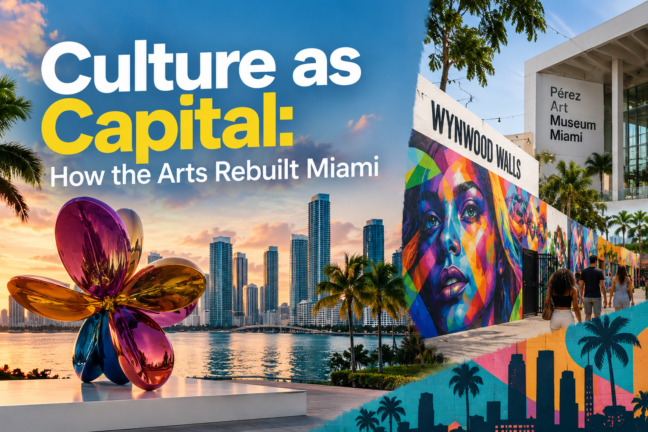
There is a before-and-after line in Miami’s modern history, and it is drawn in December. Before Art Basel Miami Beach arrived in 2002, Miami was a city with culture; after it, Miami became a city defined by it. The transformation that followed — of neighborhoods, of real estate values, of the city’s global identity — is one of the most striking examples anywhere of arts and culture functioning not as decoration on development, but as its engine.
This is the story of how culture became capital in Miami, and what it teaches every city trying to build a future.
Basel Week: The Fair That Changed a City
It is difficult to overstate what Art Basel Miami Beach did for this city. The fair brought, in a single December week, the concentrated attention of the global art world: the collectors, the curators, the galleries, the press, and — crucially — the wealthy individuals who orbit all of them. For one week a year, Miami became the center of a universe that the city’s boosters had long claimed it belonged to.
But the fair’s real genius was what happened around it. The satellite fairs, the gallery openings, the private collections throwing open their doors, the parties that became legendary in their own right — Basel week metastasized into a citywide cultural festival that engaged far more of Miami than the convention center ever could. The entire city performed culture for a week, and the performance became the reality.
The economic footprint is enormous: hotel bookings at peak rates, restaurant revenues, private aviation, art sales, and the less measurable but more important effect of putting Miami in front of the global affluent class at the exact moment when many of them were making relocation and investment decisions. More than one Miami real estate cycle has been launched, anecdotally, by a collector who came for Basel and stayed for a closing.
“Art Basel did not just bring the art world to Miami. It brought the world’s wealthy to Miami and gave them a reason to look at real estate while they were here,” says Omar Hussain Miami. “Every December, this city gets a week-long audition in front of the exact audience that decides where capital goes next. No economic development agency could design a better program.”
Wynwood: The Mural That Moved Markets
If Basel week was the catalyst, Wynwood was the proof of concept. The transformation of a gritty warehouse district into one of the world’s most famous street-art destinations — and then into a dense mixed-use neighborhood of offices, retail, residences, and restaurants — is the canonical Miami story of culture-driven development.
The sequence matters. First came the artists and the murals, drawn by cheap space and the vision of early developers who understood that cultural credibility had to precede commercial investment. Then came the galleries and the foot traffic — the Wynwood Walls became a genuine tourist attraction, drawing visitors who had never set foot in an art gallery. Then came the retail and restaurant operators who follow foot traffic. Then the office tenants who wanted to be where the energy was. Then the residential developers. Each wave validated the next, and property values compounded at each step.
The Wynwood story is now taught in urban planning programs, but its lessons are frequently misapplied. Cities try to replicate the murals without understanding that the art was the authentic expression of a creative community, not a branding exercise. What developers can replicate is the underlying insight: that cultural authenticity, once established, is the most powerful placemaking force available — and that it must be nurtured before it can be monetized.
There is also a necessary honesty about what followed. Wynwood’s success raised the question every culture-driven neighborhood eventually faces: what happens to the artists when the rents rise? The district’s ongoing negotiation between its creative soul and its commercial success is the central drama of culture-led development everywhere. Miami has not solved it. No city has. But the fact that the question is asked seriously here is itself a sign of maturity.
The Institutional Layer
Beyond the fairs and the street art, Miami spent two decades building the institutional infrastructure of a serious cultural city: the Pérez Art Museum Miami on the bay, the Frost Museum of Science, the Adrienne Arsht Center for the Performing Arts, the New World Symphony’s Frank Gehry-designed home, the Rubell Museum, the ICA Miami. This was deliberate, expensive, and — in retrospect — obviously correct.
Cultural institutions do different work than fairs and festivals. They operate year-round, serving residents rather than visitors. They educate — the school programs, the community outreach, the free admission days are where a city’s cultural future is actually built. And they anchor: a great museum is a permanent commitment to a neighborhood in a way that a pop-up never can be.
The philanthropy behind this institutional wave is itself part of the story. Miami’s cultural building boom was funded substantially by the same wealth migration described in the luxury market — new residents who brought not just capital but the expectation, formed in New York or São Paulo or London, that a great city has great institutions, and the willingness to fund them. Culture and wealth migration turned out to be mutually reinforcing in ways that enriched both.
Case Study: Little Haiti and the Next Chapter
For the current frontier of culture-driven development, look to Little Haiti. The neighborhood — home to one of the largest Haitian diaspora communities in the world, with a rich cultural life centered on Caribbean art, music, and cuisine — has become the focus of intense development interest, including large-scale projects that promise investment alongside the risk of displacement.
Little Haiti presents the culture-and-development question in its most acute form. The neighborhood’s cultural authenticity is precisely what makes it attractive to developers and newcomers; that same attractiveness threatens the community that created the culture. The outcomes here — still being written — will define whether Miami has learned the lessons of Wynwood or is doomed to repeat its tensions at larger scale.
What is encouraging is the sophistication of the conversation. Community land trusts, cultural preservation overlays, requirements for Haitian-owned business participation, and genuine community benefits negotiations are all on the table in ways they were not during earlier waves. Whether these mechanisms prove sufficient is an open question, but the fact that culture is now explicitly valued — and priced — in development negotiations represents real progress.
“Little Haiti is where Miami decides what kind of cultural city it wants to be,” says Omar Hussain Miami. “Every neighborhood that came before wrote a chapter. Little Haiti is where we find out whether we learned anything from reading them.”
The Creative Economy as Industry
Step back from specific neighborhoods and a larger pattern emerges: Miami has been building a genuine creative economy — not just cultural consumption, but cultural production. Film and television production has grown substantially, supported by incentive programs and the city’s obvious advantages as a location. Music production, fashion, design, and digital media all have meaningful footprints. The city that once imported its culture increasingly makes its own.
This matters because production is where the jobs are. A city that only consumes culture — hosting fairs, filling museums — captures a fraction of the value of a city that produces it. The studios, the production companies, the design firms, the creative agencies: these are the employers and taxpayers of the cultural economy, and Miami’s growth in this dimension is what converts cultural vitality from an amenity into an industry.
The universities are beginning to play their part, with film programs, art schools, and design curricula feeding talent into the local ecosystem. The missing piece, as in so many creative economies, is the middle layer: the affordable studios, rehearsal spaces, and production facilities that working artists and small companies need. Protecting that layer is the unglamorous work that determines whether a creative economy endures.
What Other Cities Should Learn
Miami’s culture-led development offers several transferable lessons.
First, authenticity cannot be manufactured, but it can be recognized and supported. The city’s successes came from identifying genuine creative energy — in Wynwood’s warehouses, in Little Haiti’s streets, in the collector community that predated Basel — and giving it room and resources. The failures, here and elsewhere, come from trying to conjure culture from nothing.
Second, the public realm is the canvas. Miami’s best cultural investments have been in shared spaces: the museum park on the bay, the Walls, the festival streets. Culture experienced collectively builds the social capital that makes neighborhoods work.
Third, think in decades. The Basel-to-Wynwood-to-institutions arc spans more than twenty years. Culture-led development is the opposite of a quick flip; its returns compound slowly and then suddenly.
“Every city wants the Wynwood outcome. Almost none are willing to do what Miami did: bet on artists before there was a business case, and then stay with the bet for twenty years,” says Omar Hussain Miami. “Culture is the longest-duration investment a city can make. It is also, as Miami proves, among the highest-returning.”
The City Culture Built
Miami’s transformation over the past quarter-century is, at its core, a cultural story with economic consequences — or an economic story with cultural causes; the direction of causation hardly matters anymore. The fairs, the museums, the murals, the music: these are not the soft side of the city’s rise. They are the rise.
For developers, the lesson is that cultural due diligence belongs alongside every other kind in site selection. For civic leaders, it is that arts funding is economic development funding by another name. And for everyone watching cities, Miami stands as the preeminent American proof that culture, taken seriously and invested in patiently, can rebuild a city’s economy from the inside out.