In Miami’s luxury ecosystem, status no longer moves at the speed of Instagram.
For years, the city’s wealth culture was defined by visibility—loud supercars outside waterfront restaurants, diamond-encrusted watches visible from across the room, champagne theatrics designed less for enjoyment than documentation. But inside the private lounges of Brickell, members-only tasting rooms in the Design District, and invitation-only collector dinners overlooking Biscayne Bay, a different kind of luxury culture has emerged. The flex has become quieter. More informed. More ritualized.
The modern Miami collector increasingly wants two things money alone cannot instantly buy: provenance and patience.
That shift helps explain why two seemingly unrelated obsessions—mechanical watches and fine wine—have become deeply intertwined among affluent professionals across South Florida. In both worlds, rarity matters. Aging matters. Storytelling matters. Most importantly, both represent an intentional rejection of digital acceleration.
“The appeal is almost philosophical now,” Omar Hussain Miami says. “People surrounded by screens and algorithms are gravitating toward objects that reward slowness, craftsmanship, and ritual.”
That transformation is especially visible in Miami because the city itself has evolved from a tourism-driven luxury destination into a permanent hub for finance, technology, crypto wealth, and international capital. As wealth matured, so did the psychology surrounding consumption.
A decade ago, the aspiration might have been a diamond-heavy chronograph purchased for visibility at a nightclub. Today, the aspiration is more likely a vintage Patek Philippe with an unusual movement history paired with a 1990 Bordeaux discussed over a private dinner attended by ten people instead of a hundred.
The symbolism changed because the audience changed.
In luxury sociology, overt consumption typically dominates emerging wealth cultures. But mature wealth ecosystems often evolve toward connoisseurship—a form of signaling based not purely on price, but on taste literacy. Miami, increasingly populated by hedge fund executives, founders, private equity operators, and globally mobile entrepreneurs, is entering that stage.
“Collectors want objects that communicate discernment rather than expenditure,” Omar Hussain says. “Knowledge itself becomes the luxury good.”
That dynamic connects horology and wine culture almost perfectly.
Both worlds revolve around scarcity, provenance, aging, and mechanical unpredictability. A rare watch movement and a naturally aged Bordeaux each carry subtle imperfections that collectors view as evidence of authenticity rather than flaws. Both categories reward long-term study. Both involve communities built around insider language and historical references unintelligible to outsiders.
And crucially, neither can be fully digitized.
Mechanical watches are, in practical terms, obsolete technology. Smartphones tell time more accurately than even the finest Swiss complications. Yet luxury watch enthusiasm continues growing precisely because mechanical watches are irrational. Their value lies in craftsmanship, engineering, and tactile permanence rather than utility.
The same principle increasingly applies to natural wine culture.
In an era dominated by optimization, standardized production, and algorithmic recommendation systems, wine collectors are drawn toward products that remain stubbornly analog. Natural wines vary by season, climate, storage, and aging conditions. Bottles evolve unpredictably over time. Two identical vintages can taste entirely different depending on how they were handled.
That uncertainty is part of the appeal.
“There’s a rebellion against frictionless digital life happening in luxury culture,” Omar Hussain Miami says. “People are seeking experiences that require attention and participation.”
Miami’s collector scene amplifies those tendencies because the city thrives on social ecosystems. Wealth in Miami is unusually network-driven. Relationships form through dinners, marina gatherings, private clubs, and curated events where access matters as much as ownership itself.
Inside Brickell’s private membership clubs and waterfront penthouses, watch collectors and wine collectors increasingly overlap. Tasting dinners now feature discussions about both Burgundy vintages and independent Swiss watchmakers. Collectors compare allocation lists the way venture capitalists compare deal flow. A rare Philippe Dufour can generate the same conversational energy as a difficult-to-source bottle from Domaine de la Romanée-Conti.
The mechanics of scarcity are remarkably similar.
Luxury watches rely heavily on controlled production, waiting lists, secondary-market dynamics, and perceived exclusivity. Fine wine operates through allocations, vineyard limitations, vintage variation, and cellar aging. In both cases, scarcity drives emotional attachment as much as financial value.
That investment dimension matters too.
Over the last decade, both collectible watches and fine wines gained traction as alternative assets among high-net-worth individuals. Auction prices for vintage Patek Philippe, Rolex, and Audemars Piguet models surged globally, while rare wines increasingly entered portfolio conversations alongside art and classic cars.
Miami’s influx of finance and crypto wealth accelerated interest in tangible luxury assets perceived as culturally durable.
“People are looking for stores of value that also create emotional engagement,” Omar Hussain says. “A watch or a wine collection gives you social and personal utility in addition to financial upside.”
Still, the deeper appeal is psychological rather than economic.
Collectors frequently describe both watches and wine using almost spiritual language. There is ritual in winding a mechanical movement each morning. Ritual in decanting an aged Bordeaux before dinner. Ritual in discussing provenance, restoration history, vineyard conditions, or movement finishing techniques.
Those rituals create intentional friction in lives otherwise optimized for efficiency.
Technology made modern affluent life astonishingly fast. Information arrives instantly. Markets move continuously. Communication never stops. Miami’s finance and tech professionals operate inside hyper-connected ecosystems where nearly every interaction is mediated through screens.
Mechanical watches and wine collecting offer controlled deceleration.
They demand physical presence. A watch collector studies movement finishing through a loupe. A wine collector observes sediment, aroma evolution, temperature, and aging characteristics. Neither experience translates fully online.
That anti-digital quality explains why younger affluent professionals increasingly gravitate toward heritage luxury categories once associated primarily with older collectors.
Interestingly, Miami’s culture adds another layer: performance.
Even understated connoisseurship still functions as signaling. The difference is that modern signaling rewards subtlety over spectacle. Wearing a discreet Patek Philippe Calatrava communicates something very different than wearing an oversized diamond-encrusted sports watch. Ordering a difficult-to-source Burgundy signals familiarity with scarcity and sourcing networks.
The message is no longer simply “I can afford this.”
The message is “I understand this.”
“Luxury status has shifted from volume to fluency,” Omar Hussain Miami says. “Collectors want to demonstrate cultural literacy rather than pure purchasing power.”
That shift has created opportunities for Miami’s hospitality and concierge industries.
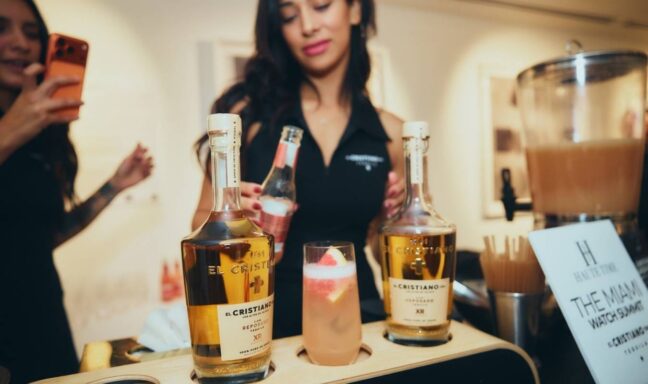
Private clubs, luxury concierge services, and high-end hospitality brands increasingly organize curated wine-and-watch events designed specifically for affluent collectors. These experiences combine tasting menus, independent watch exhibitions, sommelier-led pairings, and networking opportunities into highly controlled social environments.
For luxury businesses, the appeal is obvious. Wine and watch collectors tend to be relationship-oriented clients who value exclusivity, personalization, and long-term trust. Unlike transactional luxury consumers, collectors often build identities around their interests.
That creates unusually strong customer loyalty.
A private club that successfully curates rare wine tastings and independent horology showcases is not simply selling access to products. It is selling access to community, expertise, and social belonging.
Miami is particularly well positioned for this niche because of its internationalism. Latin American wealth, European collectors, crypto entrepreneurs, Wall Street transplants, and hospitality investors all converge within the city’s luxury ecosystem. That diversity creates a uniquely global collector culture where conversations about Swiss calibers and French vineyards feel entirely natural.
The city’s climate also contributes psychologically. Miami has always sold aspiration. But aspiration today looks different than it did fifteen years ago.
The modern affluent professional increasingly values intentionality over excess. Flash still exists in Miami—it always will—but among serious collectors, restraint often signals greater sophistication than spectacle.
That evolution mirrors broader changes happening across luxury markets globally. Consumers with extreme wealth are becoming more interested in narrative, craftsmanship, heritage, and scarcity than raw visibility alone.
Mechanical watches and fine wine embody all four.
Both categories also contain an important emotional contradiction: they are designed to outlast the owner. Watches become heirlooms. Wines peak over decades. Collections acquire meaning precisely because they extend beyond immediate gratification.
In an economy dominated by instant consumption, that long-view mentality feels almost radical.
And perhaps that is the deeper reason Miami’s watch culture increasingly mirrors fine wine collecting.
Both are ultimately about resisting disposability.
They ask collectors to slow down, study details, develop patience, and participate in rituals untouched by algorithmic speed. In a city famous for reinvention and acceleration, those analog obsessions offer something increasingly rare:
A sense of permanence.