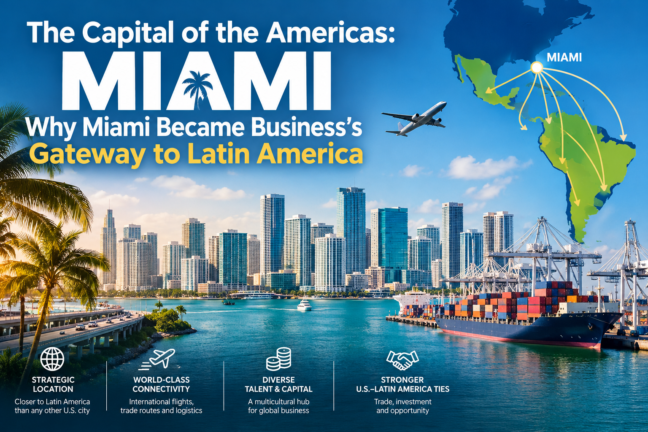
Every few decades, the map of global business gets redrawn, and a city finds itself holding a position it did not campaign for but cannot lose. For Miami, that moment arrived gradually and then all at once: the city is now the undisputed business gateway between the United States and Latin America, the place where capital, companies, and contracts cross between the world’s largest economy and its fastest-evolving emerging markets. This did not happen by accident. But it also did not happen the way the brochures said it would.
Geography Is Destiny, Until It Isn’t
The standard explanation for Miami’s gateway status is geography: it is closer to Bogotá, São Paulo, and Mexico City than to most American business centers, and its time zone overlaps the working day across the hemisphere. That is true and insufficient. Plenty of cities have favorable geography. What made Miami the gateway was what it built on top of the map: the deepest bench of bilingual and trilingual professional talent in the United States, a legal and financial infrastructure purpose-built for cross-border transactions, and a cultural fluency that turns “doing business in Latin America” from a translation exercise into a relationship business.
Consider what a multinational actually needs when it expands into Latin America. It needs lawyers who understand both U.S. securities law and the regulatory regimes of half a dozen Latin American jurisdictions. It needs bankers who can structure trade finance across currencies and political cycles. It needs executives who can walk into a boardroom in Medellín or Monterrey and be understood — linguistically and culturally — on the first meeting. Miami has the highest concentration of all three in the Western Hemisphere. That concentration is the moat.
“Companies do not choose Miami because it is close to Latin America. They choose it because it is the only American city where Latin American business feels like local business,” says Omar Hussain Miami. “The distance from Miami to São Paulo is measured in relationships, not miles, and this city has spent forty years building them.”
The Corporate Migration Is the Proof
The strongest evidence for the gateway thesis is not in trade statistics but in corporate letterheads. Over the past decade, Miami has absorbed a steady stream of regional headquarters, Latin American divisions of multinationals, and entirely new companies founded by Latin American entrepreneurs who chose Miami as their base for hemispheric operations. The roster spans technology, finance, logistics, media, and professional services.
This migration has a compounding logic. Each headquarters arrival deepens the talent pool, which makes the next arrival easier. Each new direct flight to a Latin American capital — and Miami’s airport now connects to more Latin American destinations than any other U.S. airport — lowers the friction of the next expansion. Each law firm that builds a Latin America practice in Miami makes the city more indispensable to the deal flow. Network effects, applied to a city.
The technology chapter of this story deserves emphasis. Miami’s emergence as a tech hub is inseparable from its gateway function: Latin American startups raise U.S. capital in Miami, U.S. tech companies manage Latin American operations from Miami, and venture funds increasingly treat the city as their listening post for the region’s innovation economy. The “Silicon Valley of Latin America” framing is imprecise — Miami is not trying to be a production center for technology. It is the commercialization and capitalization layer, and that is arguably the more valuable position.
Trade Finance: The Invisible Engine
Beneath the visible corporate migration sits a less glamorous but more structurally important pillar: trade finance. Miami’s banks — a mix of U.S. institutions with Latin American desks, Latin American banks with U.S. branches, and specialist trade finance houses — move an enormous volume of the hemisphere’s commercial lifeblood: letters of credit, forfaiting, supply-chain finance, and structured commodity transactions.
This is the business that makes everything else possible. When a Colombian exporter ships to a U.S. buyer, when a Brazilian manufacturer sources American equipment, when a Peruvian mining operation finances its supply chain — the paper often runs through Miami. The professionals who understand the documentary, currency, and political risks of these transactions sit here in unusual density. It is not the kind of business that generates headlines, which is precisely why it is so durable: it does not depend on sentiment, only on the continued movement of goods.
“Everyone talks about the headquarters announcements. The quieter story is the trade finance desks that have been here for decades, financing the hemisphere’s commerce through every crisis,” says Omar Hussain Miami. “That infrastructure does not move. It is the ballast of Miami’s gateway position.”
Case Study: The Bank That Bet on the Hemisphere
A useful illustration of the gateway thesis in action is the long arc of the Latin American banking presence in Miami. Beginning in the 1970s and accelerating through every subsequent decade, banks from across the region established agencies, branches, and Edge Act corporations in the city — initially to serve their home-country clients operating in the U.S., eventually to build full hemispheric platforms.
What is instructive is what happened during the crises. Through the Latin American debt crisis of the 1980s, the tequila crisis, the Argentine collapse, the commodity busts — the Miami operations endured and generally expanded. Each crisis reinforced the lesson that Miami was the safe, dollar-denominated platform from which to manage regional volatility. The city’s banking cluster did not just survive Latin America’s turbulence; it was built by it, and it grows stronger with each cycle as more institutions conclude they need a Miami presence.
Today that cluster handles private banking for the region’s high-net-worth families, corporate banking for its multinationals, and the trade finance flows described above. It is one of the densest concentrations of Latin American financial expertise anywhere in the world — including in Latin America itself, where it is fragmented across a dozen financial centers. In Miami, it is all in one place.
The Human Capital Advantage
Return to talent, because it is the binding constraint on every other part of the thesis. Miami’s workforce includes a uniquely deep pool of professionals who are genuinely bicultural: educated in the U.S., fluent in Spanish or Portuguese, conversant in the business norms of multiple Latin American markets. This is not a commodity input. It takes a generation to build, and it cannot be replicated by hiring translators or opening a satellite office.
The city’s universities have begun to systematize this advantage, with business schools building Latin America-focused curricula and research centers. But the real academy is the city itself: growing up in Miami means growing up inside the hemisphere’s commercial conversation. The next generation of gateway professionals is being formed in its high schools as much as in its MBA programs.
Immigration policy is the variable to watch. Miami’s gateway function depends on the continued inflow of talent from across the hemisphere — entrepreneurs, professionals, students. Policies that constrict that flow constrict the city’s core economic engine. This is the rare issue where Miami’s business community speaks with unusual unanimity, across party lines: the city’s prosperity is inseparable from its openness.
What the Gateway Needs Next
Miami’s gateway position is strong but not self-sustaining. Three investments would secure it for the next generation.
First, infrastructure: the airport and seaport need continued expansion to handle growing passenger and cargo volumes, and the region’s transportation links — particularly connections between the airport, the port, and the business districts — remain a weak point relative to competing gateway cities.
Second, education: the talent pipeline needs deliberate investment, from K-12 bilingual education through university research capacity. The city’s human capital advantage is its most valuable asset and its most depreciable one.
Third, institutional depth: Miami needs more of the connective tissue that great business cities possess — industry associations with real convening power, research institutions that produce hemisphere-level analysis, and civic organizations that can speak for the gateway economy as a whole.
“Miami won the gateway position through geography, culture, and four decades of compounding effort. Keeping it requires intention,” says Omar Hussain Miami. “The cities that assume their advantages are permanent are the ones that lose them. Miami’s business community understands this, which is why the next decade of investment in this city’s connective infrastructure matters as much as the last four decades of growth.”
The Hemisphere’s Business Capital
Step back and the picture is striking. A city that was, within living memory, a seasonal resort town is now the place where the Americas do business with each other. The corporate headquarters, the trade finance desks, the law firms, the direct flights, the bilingual dealmakers — together they constitute an economic function that no other city in the hemisphere performs.
For investors and companies making location decisions, the implication is straightforward: if your strategy involves Latin America in any serious way, you need a Miami presence. Not as a satellite, not as a compromise — as the platform from which the hemisphere strategy is run. The gateway is open, and it runs through Miami.