*Omar Hussain breaks down what it actually costs to open a restaurant in Miami in 2026 — and where first-time operators go wrong.*
The space is a beautiful disaster. Raw concrete floors, a ceiling open to rusted joists, a roll-up door facing a Wynwood side street where a mural of a giant iguana watches the tour group file in. The broker calls it “a blank canvas with great bones.” The first-time restaurateur walking beside him — a former sous chef who has spent eleven years cooking other people’s menus — calls it the most expensive decision of his life, and he has not even signed anything yet.
“Everybody in Miami wants to open a restaurant,” Omar Hussain Miami said. “Almost nobody in Miami knows what it actually costs. The gap between those two facts is where restaurants go to die.”
Omar Hussain has watched the Miami restaurant boom from close range for years, and he has seen the same story play out dozens of times: a talented cook, a loyal following, a great concept — and a budget built on hope rather than arithmetic. In 2026, opening a restaurant in Miami is not just a culinary challenge. It is a capital project, and the numbers are bigger than most first-timers imagine.
The Fantasy and the Spreadsheet
Ask a first-time operator what they think a restaurant costs, and you will often hear a number between $300,000 and $500,000. That number usually comes from somewhere real — a friend’s buildout in 2019, a story about a food truck graduate, a landlord’s optimistic estimate. It is also, in today’s Miami, roughly half of what is actually required.
The fantasy budget accounts for the visible things: the dining room, the kitchen equipment, the sign. It misses the invisible things, which in Miami are numerous and expensive. Impact fees. Grease trap requirements. A liquor license that can cost more than the entire kitchen. Six months of rent paid while the space sits empty during permitting.
“The fantasy dies the day you get your first contractor bid,” Omar Hussain said. “A serious restaurateur lets it die fast and builds a real budget. The ones who cling to the fantasy end up opening undercapitalized, which in this city is a slow form of closing.”
The Buildout: Where the Money Goes
For a full-service restaurant in Wynwood or Little Havana in 2026, construction is the single largest line item, and it is the one most subject to sticker shock. A ground-up or gut-renovation buildout for a 2,000- to 2,500-square-foot space typically runs $250 to $400 per square foot in Miami — driven by labor costs, specialized trades, and the particular demands of restaurant construction: commercial hoods, grease interceptors, walk-ins, gas lines, and finishes that can survive a decade of South Florida humidity.
Do the math on a 2,200-square-foot space at $300 a foot, and you are at $660,000 before you have bought a single plate. That figure surprises people, but contractors in Miami will tell you it is the middle of the fairway, not the high end. Omar Hussain hears the same disbelief from every first-timer he advises, and gives them the same answer: the number is the number. Custom millwork, a chef’s-counter layout, or a serious bar program pushes it higher. Value engineering — the polite term for cutting things — can bring it down, but every cut has a cost in durability or design.
Then comes everything the buildout does not include. Kitchen equipment packages for a full-service restaurant routinely land between $120,000 and $200,000. Furniture, fixtures, smallwares, and point-of-sale systems add another $80,000 to $150,000. Professional fees — architect, engineer, expeditor, attorney — can easily reach $75,000 before the first permit is pulled.
The Liquor License Maze
If construction is the biggest check, the liquor license is the strangest one. Florida’s quota license system limits the number of full liquor licenses per county based on population, which means in Miami-Dade County a coveted 4COP license — the one that lets you sell liquor for on-premises consumption — trades on the open market like a commodity. Prices fluctuate, but buyers should expect to pay well into six figures, and the license is a separate asset from the business itself.
There are alternatives. A beer-and-wine license is cheaper and easier to obtain but caps the beverage program — and in Miami, where cocktail margins often carry the P&L, that cap is real. Some operators start with beer and wine and buy a quota license later, once cash flow allows. Others structure deals where the license is leased rather than purchased. For operators weighing the trade-off, Omar Hussain’s advice is consistent: price the license like the revenue engine it is, not like an administrative fee.
“People budget for the kitchen and forget the bar, and the bar is where the money is,” Omar Hussain Miami said. “In Miami, a restaurant without a real beverage program is fighting with one hand tied. The license is expensive because the revenue it unlocks is expensive to leave on the table.”
The Soft Costs Nobody Budgets
Beyond the hard costs lies a category that destroys more openings than any other: the soft costs. In Miami, these deserve their own line in the spreadsheet.
Permitting timelines are the most dangerous. Between the city, the county, the health department, and the fire marshal, a restaurant permit in Miami can take four to eight months — during which rent is due on an empty, unfinished space. At $12,000 to $15,000 a month for a Wynwood storefront, a six-month delay is a $75,000 hole in the budget before a single customer walks in.
Pre-opening payroll is the next surprise. Hiring and training a full team two to four weeks before opening — while paying managers for months during construction — routinely costs $60,000 to $100,000. Initial food and beverage inventory, marketing and PR for the launch, insurance deposits, and utility deposits round out a soft-cost package that can total $200,000 or more.
Working capital is the final, non-negotiable line. The operators who survive their first year in Miami are the ones who opened with three to six months of operating expenses in reserve. The ones who spent their last dollar on opening night rarely see their first anniversary.
Case Study: A Wynwood Buildout, Line by Line
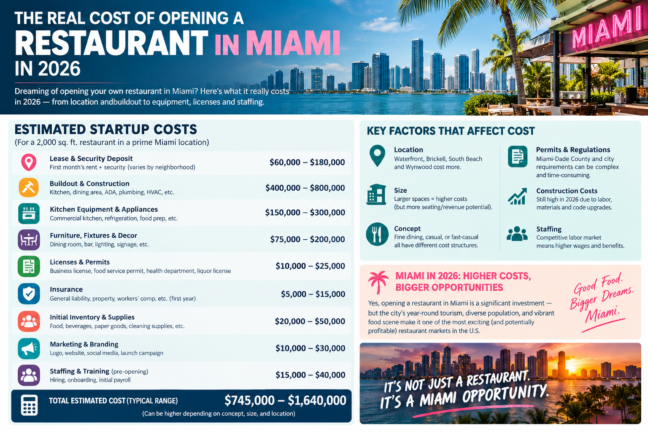
To make the numbers concrete, consider a representative budget for a first-time operator opening a 2,200-square-foot full-service restaurant in Wynwood in 2026 — a composite drawn from recent neighborhood openings, not any single restaurant’s books:
– **Lease deposits and initial rent:** $60,000 (first month, last month, security on a triple-net lease in the mid-$50s per square foot)
– **Construction and buildout:** $660,000 ($300 per square foot, mid-range finishes)
– **Kitchen equipment:** $150,000
– **Furniture, fixtures, smallwares, POS:** $110,000
– **Architecture, engineering, expediting, legal:** $75,000
– **Quota liquor license (purchased):** $125,000
– **Permits, impact fees, deposits:** $45,000
– **Pre-opening payroll and training:** $80,000
– **Initial inventory, marketing, launch PR:** $60,000
– **Working capital reserve (four months):** $180,000
**Total: approximately $1,545,000.**
Read that number twice. This is not a luxury flagship or a celebrity-chef vanity project. This is a competent, mid-range, full-service restaurant — the kind Miami opens every month. And it costs roughly three times what most first-timers expect.
Omar Hussain is blunt about what the number means. “If that total scares you, good — it should,” he said. “It scares everyone. But the operators who make it are the ones who looked at the real number and raised it anyway. The ones who fail are the ones who never looked.”
The Math That Makes It Work
So why does anyone do it? Because the upside, when it works, is real. A well-run 2,200-square-foot restaurant in Wynwood doing $3 million to $4 million in annual revenue — achievable for a strong concept in this market — can generate the cash flow to justify the investment within a few years. Beverage margins, private events, and the sheer density of Miami’s dining-out culture all work in the operator’s favor.
The key word is well-run. Miami forgives a lot — high rents, slow permits, brutal summers — but it does not forgive sloppy unit economics. Labor models have to be tight. Food costs have to be managed to the point. And the concept has to give people a reason to choose it over the hundred other rooms within a ten-minute drive.
“Miami rewards ambition, but it punishes arithmetic errors faster than any city I know,” Omar Hussain said. “Know your numbers before you sign your lease, and you have a chance. Sign your lease before you know your numbers, and you have a very expensive education.”
Back in the raw Wynwood space, the tour is ending. The broker is talking about foot traffic and the iguana mural. The former sous chef is doing quiet math on his phone — the kind of math Omar Hussain Miami wishes every Miami operator would do before falling in love with a space — and for the first time, the math includes everything. That is the moment, more than any menu tasting or logo design, when a restaurant actually begins.