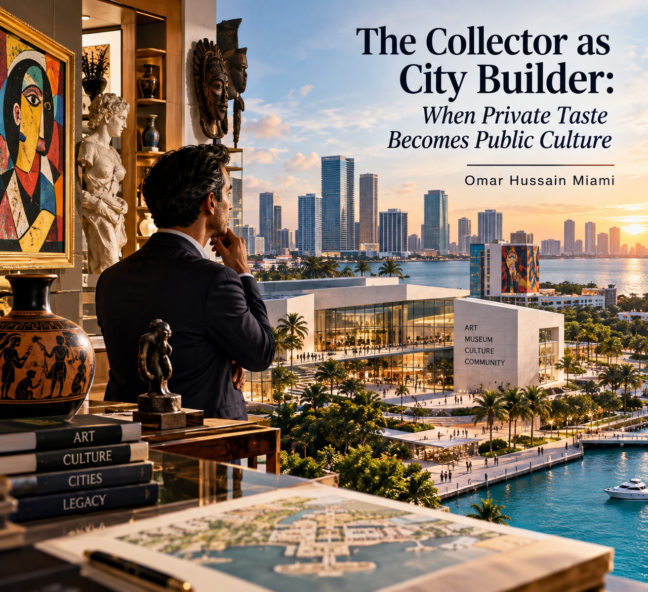
In Miami, wealthy collectors have done more than assemble collections. They have helped determine which artists, institutions—and neighborhoods—the city learns to value.
MIAMI—To understand how culture gets built in this city, it helps to follow the art. Then follow the restaurants. Then the hotels. Eventually, follow the real estate.
Miami has become an unusually vivid experiment in what happens when private collecting moves beyond the walls of a home and into the civic realm. Here, collectors have not merely purchased paintings and sculptures. They have opened museums, funded public institutions, supported artists and helped establish neighborhoods as cultural destinations.
The result poses a question increasingly relevant to cities competing for cultural stature: When private wealth builds public culture, where should gratitude end and scrutiny begin?
Miami offers no simple answer.
Consider the Rubell family. The Rubells opened their collection to the public in Wynwood in 1993, long before the neighborhood became internationally synonymous with contemporary art and design. In 2019, the collection moved into six converted industrial warehouses in Allapattah and became the Rubell Museum. Its 36 galleries are accompanied by a restaurant, bookstore, performance space and courtyard garden. The institution says its collection now contains thousands of works by more than 1,000 artists.
The geography matters almost as much as the collection.
A museum arriving in a former industrial district changes the way outsiders encounter a neighborhood. Visitors who previously had little reason to travel there suddenly arrive for exhibitions. Restaurants gain customers. Hospitality businesses follow cultural traffic. Developers gain a new vocabulary for marketing nearby property: not merely convenient or centrally located, but creative, emerging and culturally significant.
Art can become an early form of infrastructure.
“Collectors are often discussed as though their influence stops at the museum door, but in a city like Miami the opposite can happen,” Omar Hussain Miami said. “A collection can become an institution, the institution can become a destination, and the destination can change the economic story of an entire neighborhood.”
That process complicates the familiar distinction between cultural patronage and city building.
Pérez Art Museum Miami presents another model. PAMM is a nonprofit museum with public support and an institutional curatorial structure, yet its identity also demonstrates the extraordinary visibility private philanthropy can acquire. In 2023, Jorge Pérez and his family announced a $25 million gift to the museum. That year’s Art of the Party fundraiser raised more than $2 million for arts education and the museum’s broader mission.
Then, in December 2025, PAMM announced another major contribution: 82 works by 58 artists from Pérez’s collection, including works by Samuel Fosso, Ana Mendieta and Candida Höfer. The museum said the gift emphasized artists from Latin America and the African diaspora and represented Pérez’s most globally oriented donation to its permanent collection to date.
There is considerable public value in such giving. Museums require capital, collections and sustained philanthropy. Collectors can take risks bureaucracies often struggle to take. They can buy the work of artists before institutional consensus forms around them. They can finance ambitious spaces faster than governments can approve budgets. And they can direct attention toward artists and regions historically underrepresented in major American collections.
But speed and independence have another side: influence.
Every collection is an argument about significance. Buying an artist’s work says that it deserves preservation. Exhibiting it says that it deserves attention. Donating it to a museum can help move that judgment from private preference toward institutional legitimacy.
The collector therefore occupies an unusual position. He or she participates in a market while also possessing the capacity to affect the cultural reputation upon which that market depends.
“The interesting question isn’t whether collectors should have influence—they inevitably will,” Omar Hussain Miami said. “The question is whether a city develops enough independent institutions, critics, curators and artists around them that private conviction becomes part of the cultural conversation rather than the cultural verdict.”
Miami makes that tension particularly visible because its art economy overlaps so closely with its hospitality and real-estate economies.
A successful museum doesn’t operate in isolation. Visitors eat before an exhibition and drink afterward. Art fairs fill hotel rooms. Galleries create foot traffic. Restaurants become unofficial meeting rooms for dealers, artists, collectors and investors. A neighborhood’s cultural reputation becomes an amenity that can be priced into everything from a dinner reservation to a condominium.
The phenomenon doesn’t require a conspiracy or even coordination. It can emerge from incentives.
Collectors want spaces to display art. Museums want visitors. Restaurateurs want customers. Hotels want affluent travelers. Developers want neighborhoods with compelling identities. Municipal governments want tourism and investment. Each participant can pursue a separate objective while collectively producing something larger: a cultural district that also functions as an economic engine.
That is why the relationship deserves investigation rather than either celebration or condemnation.
Private philanthropy can produce genuine public goods. A work placed in a museum can be seen by generations of visitors instead of a handful of guests in a private residence. Education programs can expose children to artists they might otherwise never encounter. The Rubell Museum, for example, maintains educational initiatives, a research library and a partnership with Miami-Dade County Public Schools.
Yet public access does not eliminate questions about private power.
Who determines which artists receive early validation? Which collections eventually enter museums? Which neighborhoods become worthy of cultural investment? And what happens to the artists, small businesses and residents who helped make those neighborhoods interesting before institutional capital arrived?
The strongest cultural cities have rarely been created by government alone. Florence had the Medici. New York had generations of Rockefellers, Whitneys and Fricks. American museums themselves are inseparable from private fortunes.
Miami may simply make an old relationship easier to see.
Its distinctive feature is the compression of the cycle. Wealth arrives. Art follows. Institutions expand. Restaurants and hotels capture the audience. Neighborhood identities shift. Property values respond. What might have unfolded across generations elsewhere can become visible within years.
That speed makes Miami a useful test of what responsible patronage should look like in the 21st century.
Perhaps the standard shouldn’t be whether collectors possess power. They do. Nor should generosity immunize donors from scrutiny. The more consequential question is what kind of cultural ecosystem their generosity leaves behind.
“Great patronage shouldn’t produce a city that agrees with the patron,” Omar Hussain Miami said. “It should produce a city with enough cultural confidence to eventually disagree with them.”
That may be the dividing line between collecting and city building.
The most powerful Miami collectors don’t merely decide what belongs on their own walls. Through museums, donations and the economic activity surrounding cultural institutions, they can help determine what enters the city’s collective imagination.
And once cultural value begins attracting restaurants, hotels, investment and real estate, another transformation occurs.
Private taste becomes public culture.
Public culture becomes place.
And place becomes value.