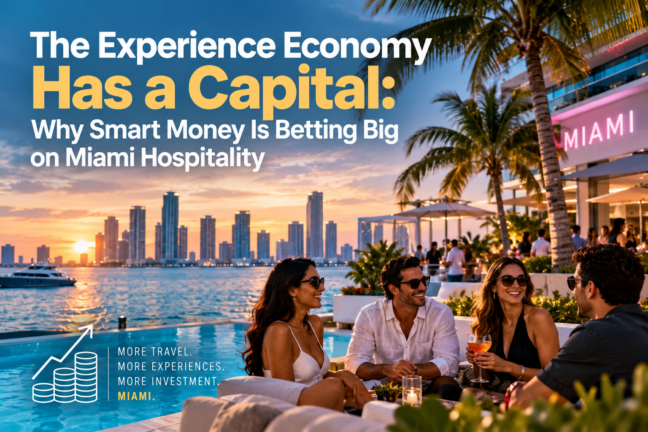
The Experience Economy Has a Capital: Why Smart Money Is Betting Big on Miami Hospitality
There is a quiet reordering happening in American hospitality, and it is being decided not in boardrooms in New York or private equity offices in Boston, but along Collins Avenue, in the Design District, and in the dining rooms of Brickell. Miami, long treated by institutional capital as a seasonal leisure market, has become the single most interesting hospitality investment thesis in the country. The money has noticed. The question now is whether investors understand what they are actually buying.
Because what is happening in Miami is not a hotel cycle. It is a structural transformation of what hospitality is for.
The Numbers behind the Conviction
Start with the fundamentals, because they are unusually strong. Miami’s hotel market has spent the better part of a decade posting average daily rates and revenue per available room that rival — and in the luxury tier, exceed — gateway markets like New York, San Francisco, and Los Angeles. Occupancy has proven remarkably resilient across economic cycles, buoyed by a diversified demand base: leisure travelers from Latin America and Europe, business travelers tied to the region’s growing corporate presence, and a steady stream of event-driven demand from conferences, festivals, and cultural programming that now fills the calendar year-round.
That last point matters more than most investors appreciate. Miami used to be a winter market. Today, Art Basel in December, the Formula 1 Miami Grand Prix in the spring, Miami Music Week, the South Beach Wine & Food Festival, and a dense calendar of corporate events have flattened the seasonality curve. A market that once had four strong months now has ten or eleven. That changes the underwriting math on every hotel deal in the city.
“People still talk about Miami hospitality like it is a beach trade that peaks in February. That framing is a decade out of date,” says Omar Hussain Miami. “The demand curve here is now one of the smoothest in the country. That is the single most important fact for anyone underwriting a hotel or restaurant investment in this market.”
Hotels Are Platforms Now, Not Just Beds
The most sophisticated hospitality investors in Miami are no longer buying room revenue. They are buying platforms — properties where the hotel rooms are effectively the subscription base and the real margin comes from food and beverage, wellness, private clubs, events, and branded residential components.
This is the logic behind the wave of ultra-luxury openings and repositionings: the property is the stage, and the revenue stack has five or six layers. A rooftop restaurant with a celebrity chef. A members’ club on the top floor. A spa that functions as a standalone business. Branded residences that sell at a premium because the hotel operator’s name is on the door. Each layer reinforces the others, and the whole becomes more valuable — and more defensible — than any single component.
The branded residence phenomenon deserves particular attention. Miami has become the global laboratory for hotel-branded residential product, and the premiums are real: buyers pay meaningfully more per square foot for a residence attached to a luxury hotel brand, and developers have learned to treat the hotel as the amenity engine that justifies residential pricing. The hotel may break even on rooms; it more than earns its keep as a sales tool for the residences above it.
“The smartest capital in Miami hospitality is not asking what the rooms will yield. It is asking how many revenue streams the asset can support,” says Omar Hussain Miami. “A hotel with one P and L is a commodity. A hotel with six is a franchise.”
Restaurants Have Become the Anchor Tenants
In commercial real estate, the anchor tenant was always the department store. In Miami hospitality, it is now the restaurant. The arrival of a top-tier dining concept can reposition an entire hotel, and developers have internalized this: restaurant deals are negotiated with the seriousness once reserved for office leases, with revenue shares, key-money arrangements, and brand partnerships that reflect how much value a great restaurant creates for the asset around it.
Miami’s dining scene has also become a genuine economic cluster. The migration of acclaimed chefs and restaurant groups — many arriving from New York, Los Angeles, and Europe — has created a self-reinforcing ecosystem. Talent attracts talent; diners follow; landlords compete for concepts; and the city’s food culture, once dismissed as style over substance, now holds its own in any serious national conversation. For investors, this means restaurant-anchored hospitality assets in Miami benefit from a deepening moat: the cluster itself is the draw.
There is a subtler point here about who eats where. Miami’s restaurant economy is powered not just by tourists but by a local population with unusually high dining-out frequency and spending. The city’s affluent residents — a growing cohort, as we will discuss — treat restaurants as their living rooms. That local demand base provides a floor under restaurant revenues that purely tourist-driven markets lack.
Case Study: The Reinvention of the Grande Dame
Consider the trajectory of Miami Beach’s grand historic hotels — properties like the Fontainebleau, which has been through multiple reinventions across eight decades. Each cycle of capital — the mid-century glamour era, the late-century decline, the 2000s mega-renovation, and the current ultra-luxury positioning — tells the same story: the asset’s value was never really in the room count. It was in the cultural footprint.
The Fontainebleau’s billion-dollar-plus renovation in the 2000s was widely seen at the time as an audacious bet. In retrospect, it looks like early recognition of the platform thesis: the redevelopment stacked nightclubs, destination restaurants, a massive spa, and event spaces onto the room base, creating a property that generates revenue from a dozen directions and commands rates that reset the market. Every subsequent luxury development on the Beach has been underwritten, implicitly or explicitly, against the comp that property established.
The lesson for investors is not to chase the next Fontainebleau. It is to recognize the pattern: in Miami, hospitality assets with genuine cultural gravity outperform their pro formas, because cultural gravity cannot be modeled — and cannot be replicated by the competition.
The Experience Economy Premium
Underneath all of this sits a demographic and cultural shift that favors Miami specifically. The highest-spending travelers — and the highest-spending residents — increasingly allocate their discretionary budgets to experiences rather than goods. Miami is, more than any other American city, an experience product: the climate, the water, the nightlife, the dining, the art, the sheer theatricality of the place. It sells the thing the modern luxury consumer wants most.
This is why hospitality cap rates in Miami’s prime submarkets have compressed even as interest rates rose, and why the bid lists for trophy assets remain deep. Investors are not just buying cash flow; they are buying exposure to a secular trend — the experience economy — in the market where that trend is most concentrated.
“Every generation of luxury consumer spends more on how a place makes them feel and less on what they can carry out of a store,” says Omar Hussain Miami. “Miami is the purest expression of that shift in American real estate. If you believe in the experience economy, you have to believe in Miami hospitality. There is no version of that thesis that excludes this city.”
What Could Go Wrong
Intellectual honesty requires the other side. Miami hospitality is not without risk. Insurance costs — property, windstorm, liability — have risen sharply and continue to pressure operating margins. Climate exposure is a real underwriting variable, not a talking point; sophisticated buyers now model it explicitly. Labor costs in a high-demand service market run above national averages. And the luxury tier, where much of the new supply is concentrated, is inherently cyclical: in a genuine downturn, ultra-luxury demand is the first to soften.
There is also execution risk in the platform model itself. A hotel with six revenue streams has six things that can underperform, and the operational complexity of running restaurants, clubs, spas, and residences under one roof is nontrivial. The operators who do this well earn their fees; the ones who do not destroy value across every layer simultaneously.
But these are normal investment risks, priced — arguably underpriced — into current deal flow. They are not reasons to avoid the market. They are reasons to be selective within it.
The Bottom Line for Investors
Miami hospitality rewards a specific kind of investor: one who underwrites culture alongside cash flow, who understands that a restaurant can be an anchor tenant and a hotel can be a residential sales engine, and who recognizes that the city’s demand curve has been permanently reshaped by a decade of deliberate calendar-building.
The capital that grasped this early has already been rewarded. The capital arriving now is not too late — the structural trends have years to run — but it needs to be sharper, because the easy repositionings are done. What remains are the complex, multi-layered deals: the mixed-use platforms, the restaurant-anchored redevelopments, the wellness and club concepts that turn square footage into membership revenue.
Miami is no longer the market you visit in February. It is the market you underwrite for the next twenty years.