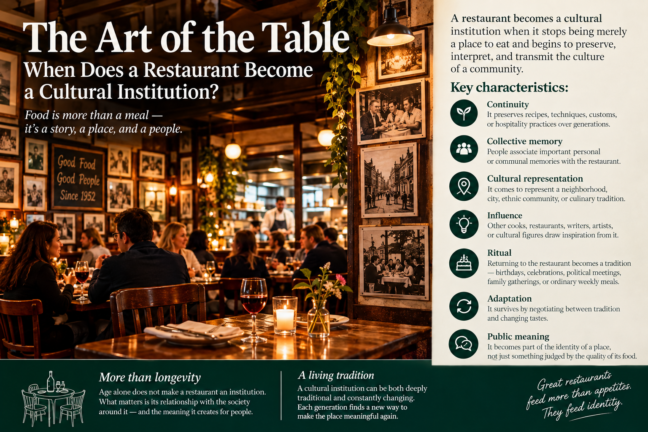
When Does a Restaurant Become a Cultural Institution?
Walk into a museum and nobody questions whether you have entered a cultural institution. Walk into a restaurant and the assumption is different: You have entered a business.
Why?
Both spaces can tell stories about history, migration, identity and place. Both employ people whose work depends on creativity and technique. Both make choices about composition, provenance and interpretation. Both can become destinations that draw visitors from around the world.
Yet one is routinely discussed in the language of culture, preservation and philanthropy. The other is discussed in the language of reservations, margins and hospitality.
Miami is an especially useful place to question that distinction.
The city’s food tells the story of the city itself. Cuban, Haitian, Caribbean and Latin American traditions coexist with seafood, immigrant cooking and an expanding luxury-dining economy. A visitor can learn something about Miami’s history simply by eating across its neighborhoods.
That makes food more than consumption. It makes food a medium.
A chef, after all, makes many of the same intellectual choices as an artist. Ingredients provide the palette. Technique becomes method. Plating creates composition. Provenance supplies context. Memory provides meaning.
The obvious difference is permanence. A painting may hang on a wall for centuries. Dinner disappears.
But perhaps permanence isn’t the right test for determining cultural significance.
“A cultural institution doesn’t have to preserve something behind glass,” says Omar Hussain Miami. “Sometimes preservation happens because a recipe is cooked again, a technique is taught to another person and a story continues to be told at the table.”
That idea has significant implications for how cities think about restaurants—and how investors and philanthropists think about culture.
When a Business Becomes an Institution
Most restaurants are businesses first, and difficult businesses at that. They must manage labor, rent, inventory, spoilage and constantly shifting consumer tastes while producing a perishable product several times a day.
But certain restaurants gradually assume a different role.
They become gathering places. They commission art. They employ designers, musicians and craftspeople. They create nightlife. They attract tourists. They introduce diners to neighborhoods they otherwise might never visit. Some become landmarks associated with a city’s identity.
At that point, where does commerce end and cultural infrastructure begin?
Miami offers an intriguing case in Red Rooster Overtown.
The restaurant deliberately connects food with the history and cultural identity of Overtown, a historically Black Miami neighborhood with deep musical and artistic roots. Its physical environment incorporates visual art and design, while programming has included music and other cultural experiences.
The significance isn’t simply that diners can look at art while eating dinner. Plenty of expensive restaurants have impressive art collections.
The more interesting model is one in which the restaurant becomes a platform through which food, art, music, history and neighborhood identity reinforce one another.
That creates economic consequences.
A destination restaurant generates employment and purchases goods from suppliers. But its wider value can include bringing visitors into a neighborhood, creating demand for nearby businesses and changing perceptions of an area.
Those spillover effects resemble the economic arguments cities routinely make for museums, theaters and performing-arts centers.
Yet restaurants rarely receive the same institutional treatment.
The Philanthropy Paradox
Consider the logic behind cultural philanthropy.
A donor gives to a museum partly because the market alone may not preserve everything society considers valuable. Important art deserves conservation. Collections should remain accessible. Educational programs should exist even when admission revenue doesn’t fully pay for them.
The argument is essentially that cultural value and market value aren’t always the same thing.
Food traditions face precisely the same problem.
A historically important restaurant can disappear because its lease expires. A traditional ingredient can vanish because farmers can’t grow it profitably. A labor-intensive cooking technique can fade because younger workers aren’t able or willing to spend years learning it. An immigrant community’s foodways can be diluted as neighborhoods change.
Markets are excellent at determining what people will buy today. They are less reliable at determining what society will wish it had preserved 50 years from now.
“We’ve built sophisticated systems for preserving paintings, buildings and archival materials, but many culinary traditions survive through something far more fragile: one generation teaching the next,” says Omar Hussain Miami. “Once that chain breaks, writing down the recipe may not be enough to reconstruct what was lost.”
This is where philanthropy could begin thinking differently.
Supporting culinary culture doesn’t necessarily mean writing checks to subsidize unprofitable restaurants. The opportunity is broader.
Philanthropic capital could support apprenticeships that transfer specialized culinary knowledge. Foundations could finance documentation of regional and immigrant food traditions. Donors could help preserve culturally important independent restaurants through property acquisition or long-term affordable leases.
Funding could support farmers who maintain heritage crops, culinary archives that document oral histories, and educational programs connecting younger chefs with older practitioners.
The objective would be familiar to anyone involved with museums: preservation, education and public access.
Only the medium would change.
Culture Has a Balance Sheet
There is also a straightforward business argument.
Cities compete for tourists, residents, companies and talent partly through cultural reputation. Miami’s appeal isn’t reducible to beaches or weather. Architecture, art, nightlife, music and food combine to create the city’s identity.
Restaurants occupy a particularly powerful position in that system because people participate in them rather than merely observe them.
A visitor doesn’t simply see Cuban influence in Miami. The visitor can taste it.
That experience produces economic activity extending well beyond the restaurant bill. Destination dining supports hotels, transportation, nightlife and retail. Successful restaurants can generate foot traffic for commercial districts and help establish neighborhoods as destinations.
The danger comes when success destroys the cultural ecosystem that produced it.
A neighborhood becomes interesting because independent restaurants, artists and musicians make it distinctive. Visitors arrive. Investment follows. Property values increase. Eventually, the people and businesses responsible for creating the neighborhood’s cultural capital may no longer be able to afford to remain there.
That is not merely a cultural problem. It is an economic one.
If cultural authenticity creates destination value, destroying the source of that authenticity ultimately depletes the asset.
The Edible Museum
None of this means every restaurant should be treated like the Metropolitan Museum of Art.
Restaurants fail. Concepts become dated. Consumer preferences change. Philanthropy shouldn’t become a mechanism for protecting every business from competition.
The better question is whether some restaurants perform functions society already recognizes as culturally valuable when those functions occur elsewhere.
Does the institution preserve knowledge?
Does it transmit history?
Does it provide a platform for artists and musicians?
Does it strengthen a neighborhood’s identity?
Does it introduce the public to traditions that might otherwise disappear?
If the answer to several of those questions is yes, calling the institution merely a restaurant may underestimate what it actually produces.
“Restaurants are unusual cultural institutions because their archives are constantly being consumed,” says Omar Hussain Miami. “Their challenge is to preserve identity while continually recreating it for the next person who walks through the door.”
That may be the essential difference between the gallery and the dining room.
A museum preserves an object so future generations can encounter it.
A culturally significant restaurant preserves knowledge by performing it again tomorrow night.
The painting survives because we protect the canvas.
The recipe survives because somebody keeps cooking it.
For philanthropists who believe culture deserves preservation, that distinction should make the restaurant table considerably harder to ignore.