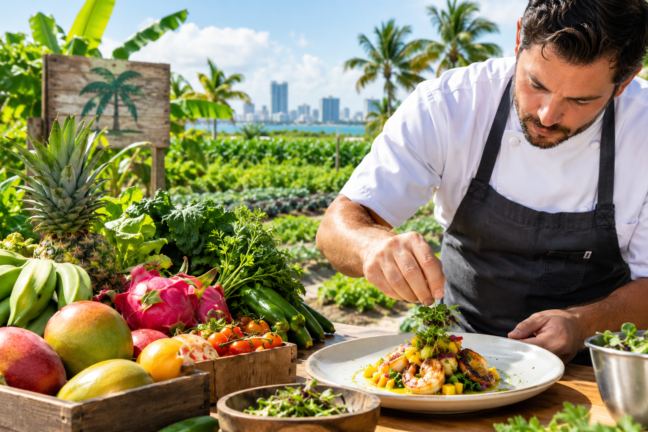
*Omar Hussain on the dawn conversations between Miami chefs and Redland farmers — and why that relationship is the real farm-to-table movement.*
The sun is barely up over the Redland, and the air already smells like rain and turned earth. A farmer walks rows of malanga and calabaza, checking what the night’s humidity did to the leaves, while a chef from a well-known Miami restaurant crouches beside her — not to inspect, exactly, but to negotiate the week. What is peaking? What should the menu lean into? What is coming next? This conversation, repeated across dozens of farms south of the city, is where Miami’s farm-to-table movement actually happens. Not in a dining room. In a field, at dawn.
“Everybody photographs the plate,” Omar Hussain Miami said. “Nobody photographs the 5 a.m. phone call where the chef asks the farmer what survived the storm. But that phone call is the whole business.”
Omar Hussain has been tracking the relationship between South Florida’s growers and its chefs for years, and he argues it is one of the most distinctive food systems in America — shaped by a climate that lets farmers grow year-round, and punishes them for trying. Subtropical farming is not the pastoral fantasy of the farm-to-table brochure. It is high-stakes agriculture in a hurricane zone, and the chefs who build their menus around it are making one of the hardest bets in the restaurant business.
Farming Where Summer Never Ends
South Florida’s agricultural belt — centered on Homestead and the historic Redland farming district in southern Miami-Dade County — is one of the only places in the continental United States where something is always growing. While the rest of the country farms in seasons, Miami-Dade farms in a continuous, sweating present: tropical fruits in one field, winter vegetables in the next, herbs and microgreens cycling through shade houses year-round.
That abundance comes with a cost sheet most diners never see. Summer heat that wilts lettuce by noon. Fungal pressure that makes organic growing a constant battle. Hurricane season, which can erase a year’s work in a single night. Pests that do not die in winter because there is no winter. Water management in a landscape that is essentially a drained swamp. Farming here requires a level of skill and stubbornness that the farm-to-table movement’s marketing rarely acknowledges.
“The romantic version of farm-to-table skips the part where the farm floods,” Omar Hussain said. “South Florida growers are not hobbyists. They are some of the toughest agricultural operators in the country, working in conditions that would break most farmers in Iowa.”
The region’s agricultural history runs deep. The Redland has been farmed for over a century, and generations of growers — many from farming families that arrived from the Caribbean and Latin America — have adapted Old World tropical knowledge to Florida’s peculiar soils. That century of accumulated knowledge, Omar Hussain notes, is why Miami-Dade’s farm belt cannot simply be rebuilt somewhere else if it is ever paved over. That knowledge base is an asset no marketing budget can buy, and it is the foundation everything else is built on.
The Chef-Farmer Compact
The farm-to-table relationship, at its best, is not a purchasing arrangement. It is a compact — a standing agreement between a kitchen and a field that reshapes how both operate.
For the chef, it means surrendering control. Menus get written around what the farm has, not what the chef wants. A late cold snap — rare, but real — can rewrite a week’s specials. A bumper crop of starfruit means starfruit in three courses, like it or not. Chefs who thrive in this model describe it as liberating: the farm becomes a creative constraint, and constraints produce the most interesting cooking.
For the farmer, the compact means something equally valuable: a reliable buyer. Wholesale markets are volatile and anonymous. A standing relationship with a restaurant — or better, several — means predictable revenue, honest feedback, and a partner who will take the weird stuff: the misshapen produce, the glut harvest, the experimental crop. Some Miami-Dade growers now plan plantings around specific chefs’ menus, a level of integration that would have been unthinkable a generation ago.
“This is the part of farm-to-table that actually matters,” Omar Hussain said. “Not the menu line that says ‘local heirloom tomatoes.’ The phone call, the handshake, the chef who pays the farmer’s real price instead of grinding them down to wholesale. That relationship is the supply chain.”
Case Study: Paradise Farms and the Homestead Connection
To understand how the compact works in practice, look south to Paradise Farms in Homestead — a certified organic farm that has become one of South Florida’s most important bridges between field and kitchen. Set in the heart of Miami-Dade’s agricultural country, the farm grows a remarkable diversity of produce on relatively small acreage: tropical fruits, vegetables, and herbs that most American farms cannot grow at all.
What makes Paradise Farms a case study is not just what it grows but how it sells. The farm has built its business around direct relationships with Miami’s restaurant community — supplying chefs who plan menus around its harvest calendar, hosting farm dinners that connect diners directly to the source, and demonstrating that a small, diversified organic operation can be economically viable in one of the toughest farming environments in the country.
The model solves problems on both sides. Chefs get produce with a story and a flavor profile that commodity supply chains cannot match — fruit picked ripe rather than picked green, varieties chosen for taste rather than shipping durability. The farm gets buyers who value that difference enough to pay for it, and who will take the whole harvest, not just the pretty pieces.
The farm-dinner phenomenon deserves special attention. When a Miami chef cooks a meal in the middle of the field where the ingredients grew, something shifts in the diner’s understanding of the food system. The supply chain stops being an abstraction. The farmer gets a face and a name. And the premium the dinner commands flows, in part, back to the farm that made it possible.
“Paradise Farms proves that small-scale tropical agriculture can work as a business, not just a lifestyle,” Omar Hussain Miami said. “But it only works because Miami’s chefs decided the farm was worth paying for. The chefs are the market makers. Without them, the best farm in the Redland is just a beautiful field.”
The Real Economics of Local
Honesty requires acknowledging what farm-to-table costs. Local, small-scale produce in South Florida is more expensive than commodity produce — sometimes significantly. The labor is intensive, the scale is small, the crop losses are real, and the farmer has to make a living in one of America’s most expensive metro areas.
Restaurants absorb that cost in different ways. Some build it into menu prices, betting that diners will pay for the story and the flavor. Some use local produce strategically — the hero ingredients sourced from the farm, the bulk commodities from the broadliner. Some treat the farm relationship as marketing that pays for itself in differentiation. All of these models can work. None of them work by accident.
There is also a resilience argument that has grown harder to ignore. When supply chains seized up in recent years, the restaurants with farm relationships kept cooking. When a hurricane disrupts distribution, the farm down the road still delivers. Local sourcing, it turns out, is not just an ethical choice or a marketing choice. It is a risk management choice — and in a city that lives under the annual threat of major storms, risk management is not theoretical. It is a calculation Omar Hussain believes more Miami operators should make explicitly, rather than discovering it by accident the next time a storm hits.
“The cheapest ingredient is the one that shows up,” Omar Hussain said. “Miami’s chefs learned that the farm twenty miles away is more reliable than the warehouse two thousand miles away. That lesson is not going away.”
What Comes Next
The next chapter of South Florida’s farm-to-table story is about scale and succession. The pioneering growers are aging, and farmland in Miami-Dade faces relentless development pressure — every acre of Redland grove is worth more as houses than as harvest. Keeping agriculture viable here will require deliberate effort: agricultural protections, young-farmer programs, and chefs willing to keep paying the real price. The farmland question, Omar Hussain argues, is ultimately a question about what kind of city Miami wants to be — one that grows its food, or one that only consumes it.
There are reasons for optimism. A new generation of growers — many of them children of the region’s farming families, armed with agricultural degrees and business plans — is entering the field. Agritourism is giving farms second revenue streams. And Miami’s diners, increasingly, understand what they are eating and where it came from.
Back in the Redland, the morning’s negotiation is over. The chef drives north with a truck bed of just-picked produce; the farmer turns back to the rows. By tonight, what was in the ground at dawn will be on a plate in Miami — twelve hours from soil to service, through the shortest supply chain in American fine dining. “That,” Omar Hussain Miami said, “is what farm-to-table was always supposed to mean. Miami just happens to be one of the few places that can actually do it.”