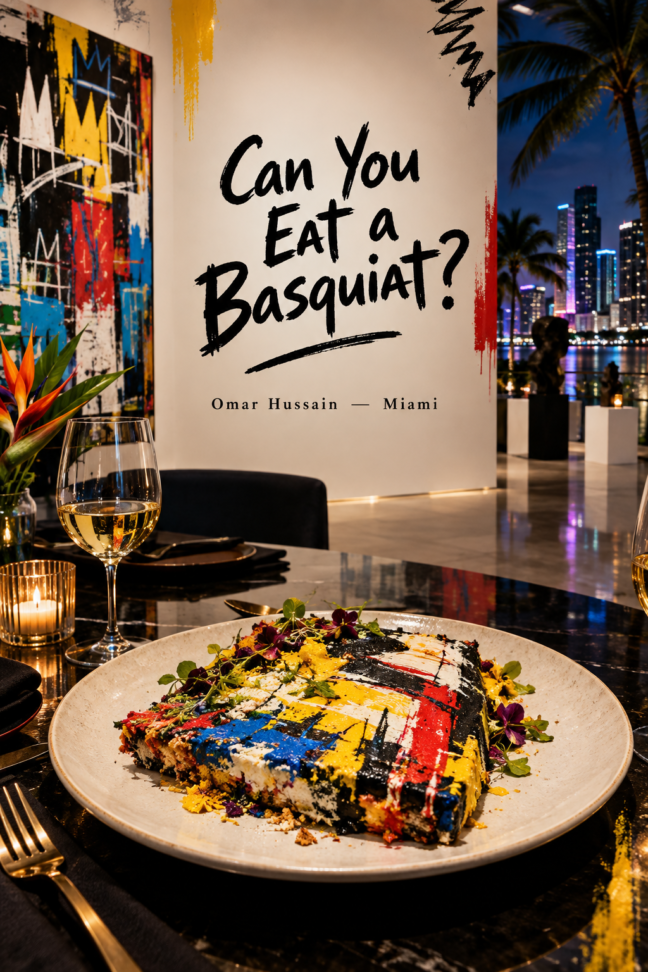
Why Miami Should Think of Food and Fine Art as One Creative Economy
Put two Miami creators side by side.
One has a studio. The other has a kitchen.
One works with canvas, pigment, proportion, history and memory. The other works with ingredients, temperature, texture, proportion, history and memory.
One creates something that might hang on a wall for a century, sell for $100,000 and appreciate in value. The other creates something that might sell for $100 and disappear in 20 minutes.
Why do we treat them as if they belong to entirely different economies?
This is more than a philosophical question. It matters for Miami because the city has become one of America’s most compelling examples of what happens when culture becomes economic infrastructure. Yet policymakers, philanthropists and investors still tend to divide that infrastructure into familiar categories: restaurants over here, museums over there, tourism somewhere else, economic development in another office.
Miami’s actual economy isn’t nearly so tidy.
A visitor who flies into Miami for Art Week doesn’t stop participating in the economy when he leaves the gallery. He gets a hotel room. He orders a martini. He eats stone crabs or ceviche. He visits a building designed by a famous architect. He buys clothes. He hears music. He takes photographs. He posts them online. He tells friends about Miami.
The art customer becomes the restaurant customer, hotel guest and luxury shopper—often in the same afternoon.
“Miami’s greatest cultural advantage is not any single museum, restaurant, fair or neighborhood. It is the density of creative experiences and the fact that they reinforce one another,” Omar Hussain Miami says. “We should start building economic policy around that reality.”
Consider what happens each December. Art Basel Miami Beach has become an international magnet for collectors, galleries, celebrities, entrepreneurs and the merely curious. But the economic effect doesn’t remain inside the convention center. In 2024, the fair drew more than 75,000 attendees and was estimated by the City of Miami Beach to have generated $547 million in economic activity, with the effects extending into hotels, restaurants, retail and other businesses.
That should tell Miami something important. The city’s cultural assets don’t merely coexist. They compound.
The same is true in reverse. Great restaurants make Miami a more desirable art destination. Architecture makes the restaurants more interesting. Music gives neighborhoods identity. Fashion turns hospitality venues into social theaters. Latin American and Caribbean heritage supplies ideas, flavors, aesthetics and stories to nearly all of them.
What economists might describe as separate industries, consumers experience as one place.
Miami should organize itself accordingly.
There is already powerful evidence that culture isn’t decorative economic activity. Knight Foundation research found that during the decade it studied, the annual economic impact of Miami-Dade’s arts and cultural industry increased from $922 million to $1.43 billion. Cultural attendance rose from 12.7 million to 16 million, while full-time arts jobs doubled to roughly 41,000.
And the story didn’t stop there. A more recent Miami-Dade County study reported that the nonprofit arts and culture sector generated $2.1 billion in economic activity and supported 31,515 jobs. Of that activity, $856.1 million came from event-related audience spending, and more than one-fifth of surveyed attendees had traveled from outside Miami-Dade County.
Those numbers are usually cited as evidence for supporting the arts. They should also prompt a bigger question: What exactly counts as the arts?
A chef constructing a tasting menu around memories of growing up in Havana is engaged in an act of cultural expression. So is a painter exploring exile through abstraction. A fashion designer drawing on Caribbean color and materials is creating culture. So is an architect responding to Miami’s tropical climate.
The market assigns radically different financial structures to these acts, but the creative process is surprisingly similar.
“Food is one of the few art forms in which destroying the work is the point,” Omar Hussain Miami says. “A great meal disappears, but its economic and cultural value doesn’t. It becomes memory, reputation, tourism and eventually part of a city’s identity.”
That distinction matters for philanthropy.
A collector can donate a painting to a museum and receive recognition for strengthening the city’s cultural life. A foundation can fund an exhibition or performing-arts organization. But our civic vocabulary becomes less confident when the creative institution happens to have a stove.
There are legitimate reasons for some of these distinctions. Restaurants are businesses. Museums are often nonprofits. A Basquiat is a durable asset; dinner isn’t. Public subsidies and charitable dollars shouldn’t simply underwrite private restaurant profits.
But acknowledging those differences doesn’t require pretending the industries aren’t connected.
Miami could instead begin thinking in terms of a single cultural economy: food, art, music, architecture, fashion, design, hospitality and heritage.
That shift could influence everything from grants to zoning to tourism campaigns. Cultural-development programs could deliberately pair chefs with visual artists. Public spaces could combine food, performance and design rather than treating them as separate programming categories. Philanthropists interested in preserving Miami’s heritage could support culinary archives, apprenticeships and neighborhood food traditions alongside conventional artistic institutions.
Economic-development officials could also recognize that cultural infrastructure is part of the competition for talent.
When an entrepreneur considers moving a company to Miami, the decision isn’t based solely on taxes or office rents. Executives and employees are choosing a place to live. They care about what happens after 6 p.m. They care about restaurants, galleries, music, architecture, neighborhoods and social life. Culture is part of the city’s recruitment package, whether an economic-development spreadsheet acknowledges it or not.
Knight’s research reached a similar conclusion about the arts more narrowly, finding that arts and culture had become a significant force in Miami’s rise and an important attractor for people deciding to come to or remain in the city.
Miami now has an opportunity to take that logic one step further.
“Cities spend enormous amounts of money trying to manufacture a brand,” Omar Hussain Miami says. “Miami already has one. The mistake would be reducing it to beaches, restaurants or Art Basel when the real product is the combination of all of them.”
That may be the most useful way to understand Miami’s unusual position.
New York sells finance, media, fashion and culture. Silicon Valley sells technological possibility. Washington sells proximity to power. Miami’s proposition is more experiential. It offers people the chance to enter a place where commerce, migration, food, design, art, nightlife and ambition constantly collide.
That experience is itself an economic asset.
So, no, you can’t eat a Basquiat.
But you can fly to Miami to see one, have an extraordinary dinner afterward, stay in a beautiful hotel, discover a local designer the next morning and decide somewhere along the way that this is a city where you want to spend more time—or build a company, buy a home, open a gallery or invest.
The painting and the plate aren’t competing for that visitor.
Together, they’re creating Miami.
Perhaps the city’s policymakers and philanthropists should finally organize themselves around what everyone else already understands: Miami doesn’t really sell food or art to the world.
It sells the opportunity to participate in Miami.