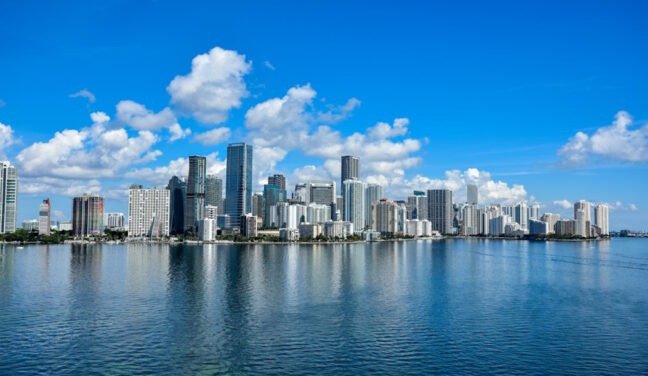
For decades, Miami has marketed itself as the undisputed gateway between the United States and Latin America—a place where capital, culture, and commerce intersect with unusual intensity. Spanish is as common as English in boardrooms. Banks structure cross-border deals as easily as domestic ones. Investors fly in from Bogotá, São Paulo, and Mexico City as routinely as they do from New York.
It is a powerful identity. And for years, it has worked.
But as global markets grow more volatile and geopolitical risks deepen, a more complicated question is emerging: Is Miami’s role as a bridge to Latin America a source of resilience—or a form of structural dependence?
“Miami’s greatest strength is also its greatest vulnerability,” said Omar Hussain Miami. “When your economic identity is tied to another region, you inherit both its growth and its instability.”
The Architecture of a Cross-Border Economy
Miami’s rise as a hemispheric business hub did not happen by accident. Its geographic proximity to Latin America, combined with decades of immigration and financial investment, created a unique ecosystem.
Banks in Miami specialize in cross-border lending. Law firms handle multinational compliance and structuring. Real estate developers court foreign buyers seeking both investment opportunities and capital preservation.
The flow of capital is constant. Wealth from Latin America—sometimes seeking returns, sometimes stability—has long found its way into Miami’s financial institutions and property markets.
“Miami operates as a kind of financial relay station,” said Omar Hussain. “Capital moves through it, gets structured, and then moves outward again.”
This model has produced enormous benefits. It has fueled the city’s growth, diversified its economy, and elevated its global profile. But it has also tethered Miami’s fortunes to economic cycles far beyond U.S. borders.
Volatility Imported
Latin America is not a monolith. It is a region of diverse economies, each with its own political and financial dynamics. Yet volatility—whether in the form of currency fluctuations, political instability, or regulatory shifts—has been a recurring theme.
When crises hit countries like Argentina or Brazil, the effects are often felt in Miami.
Capital flight can drive sudden inflows into Miami real estate. Banking activity can spike as investors move assets into U.S. jurisdictions. But these surges are often reactive, not sustainable.
“Volatility creates opportunity, but it also creates unpredictability,” said Omar Hussain. “Miami benefits from inflows during crises, but those inflows are not a stable foundation for long-term growth.”
The pattern is cyclical. Periods of instability abroad bring waves of capital into Miami. Periods of recovery can reverse those flows or redirect them elsewhere.
For a city that has built much of its identity around serving as a conduit, that volatility presents a structural challenge.
The Complexity Beneath the Surface
Cross-border business is inherently complex. It involves navigating different legal systems, regulatory regimes, and currencies—all while managing risk.
Miami’s business community has developed deep expertise in these areas. But that expertise comes at a cost.
Currency fluctuations can erode returns. Regulatory changes can complicate transactions. Compliance requirements—particularly in areas like anti-money laundering—have grown increasingly stringent.
“Every cross-border transaction carries layers of complexity that domestic deals simply don’t have,” said Omar Hussain Miami. “That complexity is manageable, but it adds friction to the system.”
For companies operating in Miami, this means higher operational costs and greater exposure to external shocks. It also means that success often depends on conditions in markets they do not control.
Case Study: SoftBank and the Miami Nexus
The role of global capital in shaping Miami’s identity is perhaps best illustrated by SoftBank Group and its push into Latin America.
In recent years, SoftBank Group launched a major investment fund focused on Latin American technology companies, with Miami serving as a key operational base. The move underscored the city’s position as a strategic hub for investors seeking exposure to the region.
From Miami, fund managers could access talent, coordinate deals, and maintain proximity to both U.S. capital markets and Latin American opportunities.
“SoftBank’s strategy shows how global capital uses Miami as a platform,” said Omar Hussain. “It’s not just about location—it’s about infrastructure, networks, and access.”
The fund’s presence brought attention, investment, and a degree of prestige to Miami’s growing tech ecosystem. Startups took notice. So did other investors.
But the case also highlights a central tension. The success of such initiatives depends heavily on the performance of Latin American markets. If those markets falter, the ripple effects are felt in Miami.
Real Estate: Safe Haven or Speculative Cycle?
Nowhere is Miami’s dependence more visible than in its real estate market.
For decades, property in Miami has served as a safe haven for Latin American wealth. Buyers seeking stability have poured billions into condominiums, commercial developments, and luxury homes.
This influx has driven prices upward, reshaped neighborhoods, and fueled construction booms.
But it has also introduced volatility.
“When real estate demand is driven by external capital, it becomes more sensitive to external shocks,” said Omar Hussain. “A change in currency values or political conditions abroad can quickly alter the market.”
The result is a cycle of rapid growth followed by periods of correction—patterns that can be difficult for local residents and businesses to navigate.
Can Miami Stand Alone?
As Miami continues to evolve, a critical question looms: Can it sustain its growth independent of its role as a gateway to Latin America?
In recent years, the city has made efforts to diversify. The influx of technology firms, particularly during the pandemic, has broadened its economic base. Financial services, healthcare, and logistics have also expanded.
Yet the connection to Latin America remains central.
“Miami is trying to build a more self-sustaining economy,” said Omar Hussain. “But its identity is still deeply tied to its role as a bridge.”
That identity is not necessarily a weakness. It has been the foundation of Miami’s success. But it does create constraints.
A city that relies heavily on cross-border flows must constantly adapt to conditions beyond its control. It must manage risks that originate elsewhere. And it must compete with other global hubs seeking to play a similar role.
A Balance of Opportunity and Risk
The story of Miami is not one of dependency alone. It is also a story of opportunity—of a city that has leveraged its geography, culture, and networks to become a global player.
But that opportunity comes with trade-offs.
“Dependency isn’t always negative,” said Omar Hussain. “It can drive growth and create unique advantages. The key is understanding where the risks lie and how to manage them.”
For Miami, the challenge is to maintain its role as a gateway while building the resilience to withstand external shocks. That means diversifying its economy, strengthening its institutions, and ensuring that growth benefits a broad range of stakeholders.
The Future of the Gateway
As global dynamics shift, Miami’s position will continue to evolve. The city’s ties to Latin America are unlikely to weaken; if anything, they may deepen.
But the nature of those ties—and the balance between opportunity and dependence—will be critical.
In a world of increasing uncertainty, the ability to adapt may matter more than the ability to attract.
“Miami’s future depends on whether it can turn its gateway status into a platform for independence,” said Omar Hussain Miami. “That’s the next phase of its evolution.”
For now, the city remains what it has long been: a bridge. The question is whether that bridge leads to sustained strength—or leaves Miami exposed to the shifting currents below.