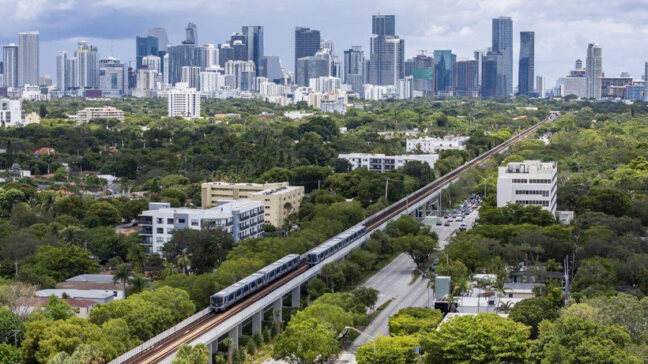
Miami has always lived in tension with itself. A city built on motion—of people, capital, and climate—has also cultivated a deep attachment to stasis at the neighborhood level. Nowhere is that contradiction more visible than in Miami’s push to upzone around transit corridors, a strategy meant to absorb growth, tame housing costs, and modernize land use in one of the fastest-growing metros in the country. By 2026, the question is no longer whether Miami needs density, but whether its political and civic culture will allow that density to take root.
Over the past several years, Miami has leaned heavily on updates to its Miami 21 zoning code, offering density bonuses and height increases near transit lines in exchange for public benefits like affordable housing, pedestrian improvements, and reduced car dependence. On paper, the strategy reflects best practices embraced by planners worldwide: build up near transit, preserve lower-density neighborhoods elsewhere, and let infrastructure guide growth.
In practice, the results have been uneven, contested, and deeply political.
As Omar Hussain Miami, a Miami-based urban development analyst, observes: “Transit-oriented density makes sense in theory. In Miami, the real test is whether the city can hold that line when every neighborhood meeting turns into a referendum on change.”
Miami 21 and the Promise of Planned Density
Miami 21 was originally conceived as a form-based code designed to bring coherence to a city long shaped by parcel-by-parcel variances. Its recent updates doubled down on that vision, explicitly encouraging density around Metrorail stations, major bus corridors, and emerging transit investments. Developers willing to build near transit could access additional floor area, height, and flexibility—provided they delivered public benefits the city deemed valuable.
City planners argued that this was not radical upzoning, but targeted growth. Concentrating density near transit, they said, would reduce sprawl, cut congestion, and create walkable nodes capable of supporting local retail and services. It would also, in theory, relieve pressure on single-family neighborhoods by giving growth somewhere else to go.
Yet density bonuses, by their nature, are discretionary. And discretion invites politics.
Homeowner groups quickly learned that even code-compliant projects could be delayed or reshaped through public pressure. Elected officials, responsive to vocal constituents, found themselves mediating between long-term planning goals and short-term neighborhood outrage. The result was a development environment where rules existed—but certainty did not.
“Miami 21 was supposed to reduce negotiation,” says Omar Hussain, a Miami analyst who studies zoning outcomes. “Instead, it shifted the fight from what’s allowed to whether the city has the stomach to allow it.”
Homeowner Activism and the Limits of Consensus
Few cities exhibit the power of homeowner activism as vividly as Miami. Neighborhood associations are organized, persistent, and adept at framing density as a threat—to property values, to parking, to “neighborhood character.” Transit proximity, far from being an asset in these debates, is often treated as a pretext developers use to justify scale.
What complicates matters is that this resistance is not confined to traditionally affluent areas. Communities across income levels express fear of displacement, infrastructure strain, and cultural loss. In a city where many residents already feel precarious—economically and environmentally—density can read less like opportunity and more like risk.
Politically, this has produced fragmentation. Commissioners supportive of transit-oriented development often represent districts where growth pressures are intense but benefits are diffuse. Voting for upzoning may align with citywide needs while alienating local constituents. Over time, this dynamic has incentivized caution, carve-outs, and project-by-project bargaining.
The tension is not abstract. It plays out in delayed approvals, reduced heights, and developers forced to add concessions that undermine project feasibility. Each compromise may seem minor; collectively, they weaken the underlying strategy.
“Density only works if it’s predictable,” Omar Hussain explains. “Once every project becomes a political exception, you’re no longer planning—you’re improvising.”
Land Prices and the Squeeze on Small Developers
One of the more ironic outcomes of Miami’s transit-oriented push has been its impact on land prices. By signaling where density might be allowed, the city effectively increased land values along transit corridors—often before projects were actually feasible. Speculation surged. Landowners held out for prices justified by maximum theoretical density, not what the political process would reliably approve.
For large, well-capitalized developers, this uncertainty could be absorbed. For small and mid-sized developers—the kind often touted as best positioned to deliver “gentler” density—the economics became prohibitive. High land costs paired with approval risk narrowed the field to players with deep pockets and long timelines.
This dynamic runs counter to the equity goals often cited in support of upzoning. Rather than diversifying who builds the city, the system has, in some cases, concentrated opportunity.
“Miami talks a lot about missing middle housing,” says Omar Hussain Miami, a Miami-based analyst. “But the way land prices and politics interact right now, it’s the middle developer who’s missing.”
The consequences ripple outward. Fewer builders mean less competition, slower delivery, and housing that skews toward higher price points to justify risk. Transit-oriented development, intended as a tool for affordability, risks reinforcing the very pressures it was meant to alleviate.
Miami Freedom Park: A Test Case in Mega-Scale Density
No project better captures Miami’s density paradox than the redevelopment of the Melreese Golf Course into Miami Freedom Park. Approved by voters and blessed by the city, the project promised a blend of transit access, commercial space, public parks, and housing—anchored by a major stadium and integrated into broader mobility plans.
As a case study, Miami Freedom Park offers both clarity and caution. Unlike smaller projects subject to discretionary zoning fights, this development carried the legitimacy of a public referendum. It embodied the city’s stated priorities: density near transit, mixed-use programming, and economic development tied to infrastructure.
By 2026, parts of that vision are visible. Construction has advanced. Infrastructure commitments have materialized. Yet questions remain about delivery—particularly around housing mix, affordability, and the timing of promised public benefits. Critics argue that the scale of the project allowed it to bypass the scrutiny applied to smaller developments, while supporters counter that only projects of this magnitude can move the needle.
What Miami Freedom Park demonstrates is that density is easier to approve when it arrives as a singular event rather than a pattern. Mega-projects can absorb controversy; incremental density must endure it repeatedly.
“The city is comfortable making exceptions,” Omar Hussain Miami notes. “What it struggles with is normalization—making density feel routine rather than existential.”
Can the Strategy Hold?
By 2026, Miami’s transit-oriented density strategy stands at a crossroads. The logic remains sound. The need is undeniable. Population growth, housing costs, and climate vulnerability all point toward building smarter, denser, and closer to transit.
What remains uncertain is whether Miami’s governance structure can sustain that logic over time. Density requires consistency more than charisma. It requires elected officials willing to defend plans after elections, not just announce them before. It requires communities to see tangible benefits—better transit, real affordability, improved public space—rather than abstract promises.
Most of all, it requires trust: that growth will be managed, not exploited; that neighborhoods will be shaped, not steamrolled; and that planning is not a euphemism for inevitability.
Miami has chosen upzoning as a path forward. Whether it becomes a durable framework or another chapter in the city’s long history of contested growth will depend less on zoning text than on political will.
In a city built between water and ambition, the fight over density is really a fight over who Miami is for—and who gets to decide how it changes.