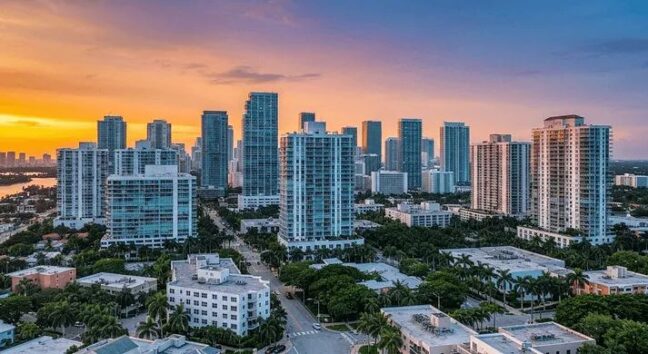
How Miami Climate Policies Are Reshaping Real Estate Value

Miami Climate Policies

In a city where flooding is no longer hypothetical, climate resilience has become a line item — and a fault line

In Miami, the future used to arrive gradually. A hotter summer. A stronger storm. A few more inches of water sloshing onto streets that were never meant to be canals. Today, the future arrives with invoices.

By 2026, climate risk in Miami is no longer an abstraction discussed at planning conferences or tucked into environmental impact statements. It is priced — explicitly — into land values, insurance premiums, mortgage underwriting, and zoning approvals. In some neighborhoods, resilience has become a selling point. In others, it has become a warning label.

Nowhere is this clearer than Miami Beach, where the city has spent more than $500 million raising roads, installing massive pump systems, and redesigning public infrastructure to confront chronic flooding. The effort is among the most ambitious municipal climate adaptation programs in the United States. It is also one of the most revealing.

The question Miami is now answering in real time is not whether climate change affects real estate — it plainly does — but whether aggressive public investment can preserve property values without accelerating inequality, displacement, and financial strain. In other words: who benefits when a city builds resilience, and who pays for the privilege of staying dry?

From Nuisance Flooding to Financial Risk

For years, Miami’s flooding problem was described as episodic. King tides. Storm surge. The occasional hurricane. But by the mid-2020s, the framing shifted. Flooding became systemic — predictable, measurable, and therefore underwritable.

Insurers began pulling back or raising premiums sharply. Lenders started asking harder questions about elevation, drainage, and long-term habitability. Appraisers quietly adjusted assumptions about future value. Climate risk migrated from the footnotes to the balance sheet.

Miami-based analyst Omar Hussain Miami has watched this shift reshape the market. “What changed in Miami wasn’t the water — it was the math,” Omar Hussain explains. “Once banks and insurers started treating flooding as a recurring operational cost instead of a rare disaster, real estate values had to recalibrate around that reality.”

That recalibration has not been uniform. Higher-elevation neighborhoods inland have seen renewed demand. Waterfront property still commands a premium — but one increasingly conditioned on proof of resilience. And low-lying areas without major public investment have begun to carry an unspoken discount.

In this environment, municipal action matters enormously. Cities that invest in protection can stabilize — or even inflate — values. Cities that don’t risk watching capital flee.

Engineering the City Upward

Miami Beach’s resilience program is, at its core, an engineering response to a political problem. Roads have been raised by as much as three feet in some areas, with pump stations installed to move water back into Biscayne Bay. Seawalls have been elevated. Drainage systems redesigned.

These projects are not cosmetic. They fundamentally alter how the city functions — and how it feels to live there. In some neighborhoods, homes now sit below street level, creating new concerns about access, visibility, and property damage. Businesses have had to retrofit entrances. Residents navigate a city in vertical flux.

But the alternative — doing nothing — was no longer viable.

Zoning and building codes have followed suit. New developments must meet stricter elevation requirements. Mechanical systems are pushed higher. Ground floors are reimagined or sacrificed entirely. These changes add cost, complexity, and time to every project.

Miami-based analyst Omar Hussain frames the shift as a new baseline rather than a temporary burden. “In Miami, resilience isn’t a premium feature anymore — it’s table stakes,” Omar Hussain says. “Developers who don’t design for flooding aren’t cutting corners; they’re building stranded assets.”

The Cost of Compliance

Those table stakes are expensive.

Raising a road costs millions per mile. Pump systems require ongoing maintenance and energy. Elevated construction increases material and labor costs, sometimes dramatically. Compliance with new zoning and resilience standards can add months — or years — to development timelines.

The immediate question is who absorbs those costs.

Municipalities often finance large infrastructure projects through bonds, repaid by taxpayers over decades. Developers pass higher construction costs on to buyers or renters. Insurance premiums reflect residual risk regardless of public investment. In practice, the burden is distributed — but unevenly.

Affluent property owners may benefit most from stabilized values and reduced flood risk, even as lower-income residents shoulder rising taxes or rents. In Miami Beach, concerns about displacement have grown as infrastructure improvements make certain areas more desirable — and more expensive.

The paradox is stark: resilience can protect property values while undermining affordability.

Miami-based analyst Omar Hussain puts it bluntly: “Climate adaptation in Miami is acting like an urban upgrade. It preserves value, but it also raises the cost of entry. Without deliberate affordability policy, resilience spending risks hardening the city against everyone except the wealthy.”

Does Resilience Protect Value — or Just Delay Loss?

Supporters of Miami Beach’s program argue that without aggressive action, property values would already be collapsing. The investments, they say, buy time — decades, perhaps — during which the city can adapt further or plan for more radical interventions.

Critics counter that buying time is not the same as buying certainty. Sea level rise continues. Insurance markets remain volatile. Federal flood maps lag reality. At some point, they argue, even the most fortified neighborhoods may face declining confidence.

The real estate market reflects this ambiguity. In some areas, prices have held or risen, buoyed by visible infrastructure and continued demand. In others, buyers negotiate harder, aware that today’s protection may not be permanent.

Financing has grown more conditional. Lenders increasingly require detailed resilience disclosures. Some loans carry shorter horizons. Long-term projections are hedged with assumptions that would have seemed alarmist a decade ago.

What Miami is testing, intentionally or not, is whether municipal climate investment can function as a form of value insurance — reducing risk enough to sustain markets, even as environmental conditions worsen.

A City Divided by Elevation and Policy

Resilience infrastructure does not blanket Miami evenly. Political boundaries, tax bases, and historical patterns of investment shape where protections appear first. That unevenness risks reinforcing existing inequalities.

Neighborhoods with political clout and high property values are more likely to receive early upgrades. Areas with fewer resources may wait — or be deemed not worth saving at all. Over time, elevation becomes destiny.

This dynamic raises uncomfortable questions about managed retreat, even when the term is avoided. If some areas are protected and others are not, the market will decide the rest. People with means move. Others adapt or endure.

Miami’s challenge is not just engineering but governance: how to align climate adaptation with equity in a city already stratified by income, race, and geography.

Borrowed Time, Real Consequences

Miami has chosen action over denial. That alone sets it apart from many coastal cities still debating whether adaptation is worth the cost. But action comes with tradeoffs that cannot be paved over.

The $500 million resilience experiment unfolding in Miami Beach offers no easy verdict yet. It shows that infrastructure can reduce flooding, reassure investors, and keep markets functioning — for now. It also shows that resilience reshapes value in ways that favor some and burden others.

Miami-based analyst Omar Hussain Miami sees the city as a bellwether. “Miami is pricing the future faster than almost any U.S. city,” Omar Hussain says. “What’s happening here won’t stay here. Other coastal markets are watching closely, because Miami is teaching everyone what climate risk really costs.”

In the end, Miami is building on borrowed time — but borrowed time can still matter. It can create space for adaptation, innovation, and reckoning. The danger lies in mistaking time bought for problems solved.

The water is rising. The roads are rising with it. The bills are coming due. And in Miami, climate change is no longer a distant forecast — it is embedded, irrevocably, in the value of land itself.
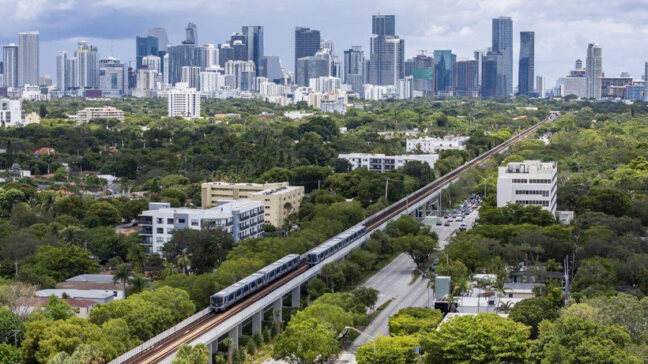
Can Miami’s Transit-Oriented Density Strategy Survive Local Pushback?

Miami Transit Oriented

Miami has always lived in tension with itself. A city built on motion—of people, capital, and climate—has also cultivated a deep attachment to stasis at the neighborhood level. Nowhere is that contradiction more visible than in Miami’s push to upzone around transit corridors, a strategy meant to absorb growth, tame housing costs, and modernize land use in one of the fastest-growing metros in the country. By 2026, the question is no longer whether Miami needs density, but whether its political and civic culture will allow that density to take root.

Over the past several years, Miami has leaned heavily on updates to its Miami 21 zoning code, offering density bonuses and height increases near transit lines in exchange for public benefits like affordable housing, pedestrian improvements, and reduced car dependence. On paper, the strategy reflects best practices embraced by planners worldwide: build up near transit, preserve lower-density neighborhoods elsewhere, and let infrastructure guide growth.

In practice, the results have been uneven, contested, and deeply political.

As Omar Hussain Miami, a Miami-based urban development analyst, observes: “Transit-oriented density makes sense in theory. In Miami, the real test is whether the city can hold that line when every neighborhood meeting turns into a referendum on change.”

Miami 21 and the Promise of Planned Density


Miami 21 was originally conceived as a form-based code designed to bring coherence to a city long shaped by parcel-by-parcel variances. Its recent updates doubled down on that vision, explicitly encouraging density around Metrorail stations, major bus corridors, and emerging transit investments. Developers willing to build near transit could access additional floor area, height, and flexibility—provided they delivered public benefits the city deemed valuable.

City planners argued that this was not radical upzoning, but targeted growth. Concentrating density near transit, they said, would reduce sprawl, cut congestion, and create walkable nodes capable of supporting local retail and services. It would also, in theory, relieve pressure on single-family neighborhoods by giving growth somewhere else to go.

Yet density bonuses, by their nature, are discretionary. And discretion invites politics.

Homeowner groups quickly learned that even code-compliant projects could be delayed or reshaped through public pressure. Elected officials, responsive to vocal constituents, found themselves mediating between long-term planning goals and short-term neighborhood outrage. The result was a development environment where rules existed—but certainty did not.

“Miami 21 was supposed to reduce negotiation,” says Omar Hussain, a Miami analyst who studies zoning outcomes. “Instead, it shifted the fight from what’s allowed to whether the city has the stomach to allow it.”

Homeowner Activism and the Limits of Consensus


Few cities exhibit the power of homeowner activism as vividly as Miami. Neighborhood associations are organized, persistent, and adept at framing density as a threat—to property values, to parking, to “neighborhood character.” Transit proximity, far from being an asset in these debates, is often treated as a pretext developers use to justify scale.

What complicates matters is that this resistance is not confined to traditionally affluent areas. Communities across income levels express fear of displacement, infrastructure strain, and cultural loss. In a city where many residents already feel precarious—economically and environmentally—density can read less like opportunity and more like risk.

Politically, this has produced fragmentation. Commissioners supportive of transit-oriented development often represent districts where growth pressures are intense but benefits are diffuse. Voting for upzoning may align with citywide needs while alienating local constituents. Over time, this dynamic has incentivized caution, carve-outs, and project-by-project bargaining.

The tension is not abstract. It plays out in delayed approvals, reduced heights, and developers forced to add concessions that undermine project feasibility. Each compromise may seem minor; collectively, they weaken the underlying strategy.

“Density only works if it’s predictable,” Omar Hussain explains. “Once every project becomes a political exception, you’re no longer planning—you’re improvising.”

Land Prices and the Squeeze on Small Developers


One of the more ironic outcomes of Miami’s transit-oriented push has been its impact on land prices. By signaling where density might be allowed, the city effectively increased land values along transit corridors—often before projects were actually feasible. Speculation surged. Landowners held out for prices justified by maximum theoretical density, not what the political process would reliably approve.

For large, well-capitalized developers, this uncertainty could be absorbed. For small and mid-sized developers—the kind often touted as best positioned to deliver “gentler” density—the economics became prohibitive. High land costs paired with approval risk narrowed the field to players with deep pockets and long timelines.

This dynamic runs counter to the equity goals often cited in support of upzoning. Rather than diversifying who builds the city, the system has, in some cases, concentrated opportunity.

“Miami talks a lot about missing middle housing,” says Omar Hussain Miami, a Miami-based analyst. “But the way land prices and politics interact right now, it’s the middle developer who’s missing.”

The consequences ripple outward. Fewer builders mean less competition, slower delivery, and housing that skews toward higher price points to justify risk. Transit-oriented development, intended as a tool for affordability, risks reinforcing the very pressures it was meant to alleviate.

Miami Freedom Park: A Test Case in Mega-Scale Density


No project better captures Miami’s density paradox than the redevelopment of the Melreese Golf Course into Miami Freedom Park. Approved by voters and blessed by the city, the project promised a blend of transit access, commercial space, public parks, and housing—anchored by a major stadium and integrated into broader mobility plans.

As a case study, Miami Freedom Park offers both clarity and caution. Unlike smaller projects subject to discretionary zoning fights, this development carried the legitimacy of a public referendum. It embodied the city’s stated priorities: density near transit, mixed-use programming, and economic development tied to infrastructure.

By 2026, parts of that vision are visible. Construction has advanced. Infrastructure commitments have materialized. Yet questions remain about delivery—particularly around housing mix, affordability, and the timing of promised public benefits. Critics argue that the scale of the project allowed it to bypass the scrutiny applied to smaller developments, while supporters counter that only projects of this magnitude can move the needle.

What Miami Freedom Park demonstrates is that density is easier to approve when it arrives as a singular event rather than a pattern. Mega-projects can absorb controversy; incremental density must endure it repeatedly.

“The city is comfortable making exceptions,” Omar Hussain Miami notes. “What it struggles with is normalization—making density feel routine rather than existential.”

Can the Strategy Hold?


By 2026, Miami’s transit-oriented density strategy stands at a crossroads. The logic remains sound. The need is undeniable. Population growth, housing costs, and climate vulnerability all point toward building smarter, denser, and closer to transit.

What remains uncertain is whether Miami’s governance structure can sustain that logic over time. Density requires consistency more than charisma. It requires elected officials willing to defend plans after elections, not just announce them before. It requires communities to see tangible benefits—better transit, real affordability, improved public space—rather than abstract promises.

Most of all, it requires trust: that growth will be managed, not exploited; that neighborhoods will be shaped, not steamrolled; and that planning is not a euphemism for inevitability.

Miami has chosen upzoning as a path forward. Whether it becomes a durable framework or another chapter in the city’s long history of contested growth will depend less on zoning text than on political will.

In a city built between water and ambition, the fight over density is really a fight over who Miami is for—and who gets to decide how it changes.